 Hisashi Space
September 14, 2026 · 6 min read
Everyone is arguing about whether AI should write their articles. That was settled in writing, and it is the wrong argument.
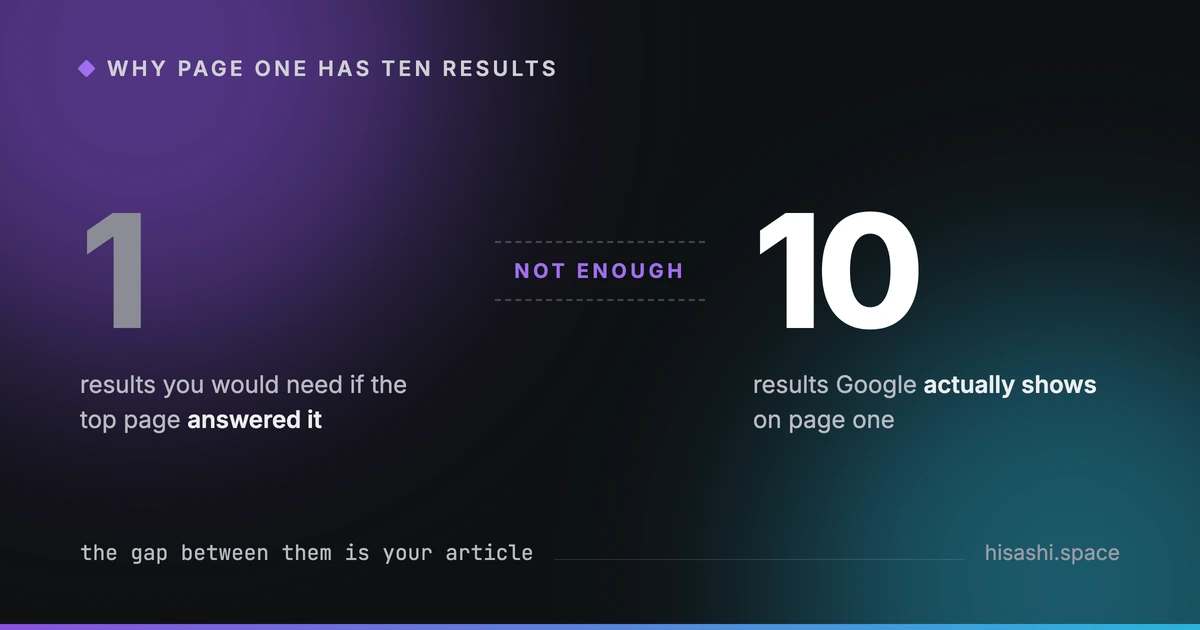
Should you let AI write your articles? The argument has been running for two years and shows no sign of settling. The people doing it mostly keep quiet about it. The people against it say Google will bury you.
The argument is over, though. Google ended it in public, in writing.
What Google actually says
Search Central, in its guidance on AI generated content: "Appropriate use of AI or automation is not against our guidelines."
The one thing that breaks the rule is generating content primarily to manipulate rankings. The same page adds: "Automation has long been used in publishing to create useful content."
So Google is not asking who typed it. It is asking whether the result is any use. Which means the popular explanation, that a piece got buried because it reads like a machine wrote it, has nothing behind it.
And yet the pieces really do go nowhere. I had plenty of my own. Same model, same length, same tidy prose as the ones that worked, and search sent nobody.
What the numbers did
Here is one of my sites, six months of Search Console.
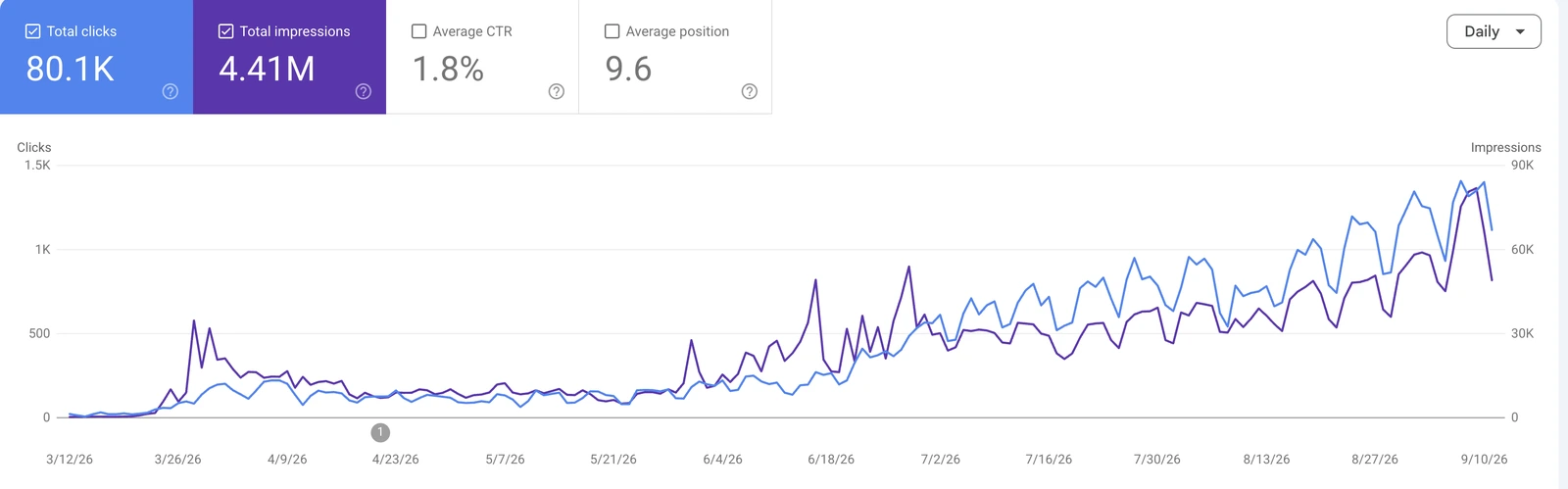
Total clicks 80.1K, total impressions 4.41M, average position 9.6.
Month to month: February took 812 clicks. August took 27,560. Impressions went from 11,709 to 1,239,231.
Nothing changed about who writes the articles across those months. The model wrote them in February and the model writes them now. The instruction changed.
One detail in there is worth keeping, because it is the earliest signal you get. Impressions multiplied by 106 and clicks by 34. That gap is not a problem to fix, it is the shape of a page climbing. A page enters the results before it ranks, so at position 20 you collect impressions and nothing else. Clicks arrive later, as position improves. Average position of 9.6 says most of this is still sitting at the bottom of page one, which is another lift still to come.
The read for anything you publish: if impressions are flat after a few months, the piece has not entered the race at all. Waiting will not change that.
Lining up the ones nobody read
When I put the failures side by side, the thing they had in common was not subtle. They said what the ten pages on page one already said.
Sit in the searcher's chair for a second. You open the first result. You find what you came for. Do you open the second one?
No. You are finished.
Google's side of it is the same arithmetic. An eleventh page carrying the same content gives it no reason to lift that page above the ten. It was never buried. There was never a reason to raise it.
Google's own page on creating helpful content hands you the test. Among the questions it asks you to put to your own work:
Are you mainly summarising what others have to say without adding much value?
Does the content provide original information, reporting, research, or analysis?
A page that reorganises what already exists fails both of those. It fails them exactly as hard when a human writes it by hand.
Why is there a second result at all?
This is the part that changed how I work, and it took me an embarrassingly long time to arrive at.
Google's stated mission is to organise the world's information and make it universally accessible and useful. Take that seriously for a moment. If the first result settles the question completely, the first result is all anybody should ever need.
That is precisely what AI mode does now. One answer. No list.
And yet ordinary search results still stack a second, a third, a fourth, all the way down. Why would they, if the mission is what it says?
Because the first one is not enough.
Once I held it that way, what to write stopped being a guessing game. Read everything currently ranking. Work out what the person is still missing after they have read the top page. Write the page that ends the search.
You are not competing with Google. You are finishing the results page alongside it.
What I ask for now
The instruction is three lines.
Read the ten pages ranking for the term. Cover everything they cover between them. Then add what none of them has.
The first two lines are where the model is straightforwardly better than I am. Reading ten pages properly and listing what they collectively cover takes me half a day and takes it a few minutes, and it does not get bored halfway through and skim.
The third line it cannot do for me at all. Cover everything and what you have made is a very complete summary, which is the thing those self assessment questions throw out.
What I add is always one of four things.
A number I measured myself. 812 to 27,560 is one of them. Nobody can copy a number. Only someone who ran the same six months can write it down.
What went wrong, with the specifics. Success stories are everywhere and they are interchangeable. The detail of a failure belongs to whoever had it.
The assumption everybody inside the field shares. Too obvious for anyone there to bother writing, and routinely the exact thing the person searching came to find.
Where my own view changed over years. That one cannot be shortcut, because it is made of time.
None of those are in the ten pages, for the simple reason that only the person who did the thing can write them.
The other number that moved
There is a second chart worth putting up, because it moved without me aiming at it.
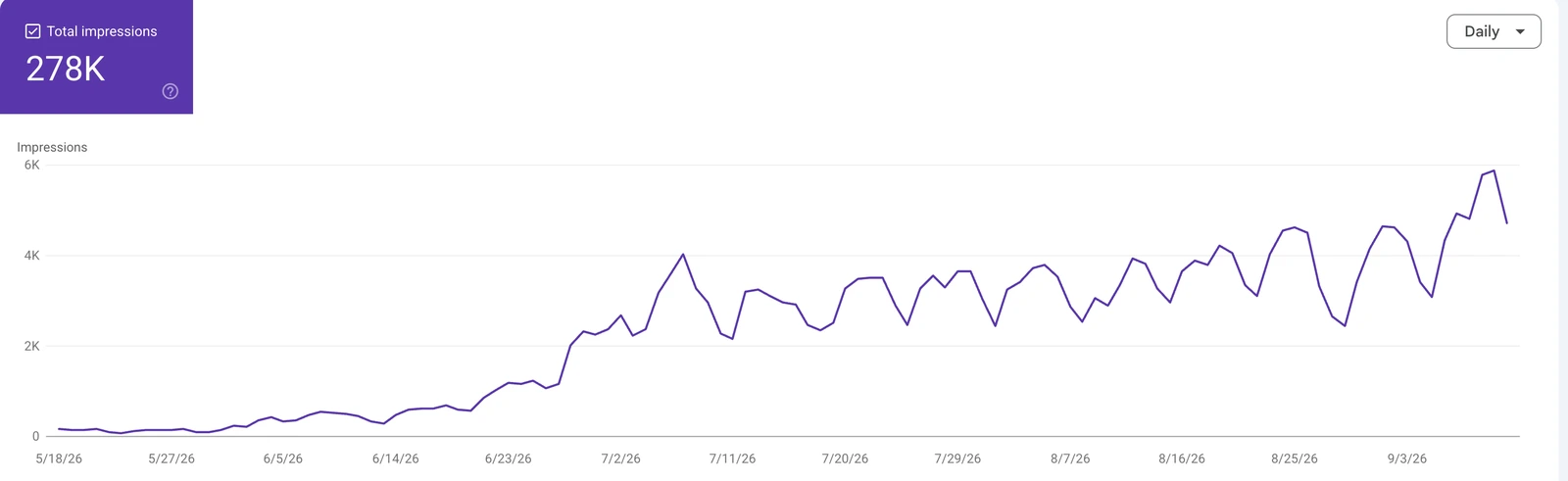
That is impressions in Google's generative AI features. Near zero until the middle of June, climbing steadily since, 278K over the period.
I did nothing different to earn that. The same pages that answer what the top ten leave unanswered are the pages a generated answer reaches for, which makes sense: a summariser has no use for the eleventh restatement of something either.
Where it stops working
Two limits, stated plainly.
Google also weighs how much it trusts the domain and how much standing the writer has. The method does not hand you first place on a term where a national newspaper is sitting there. It has worked well enough for me, on a domain I have been running since 2004, which is itself part of the answer.
And there is a cost to the fourth line that is easy to miss. In a field where I have done none of the work, I have no last move to play. I cannot add the measured number or the specific failure, because I do not have one. That is why the range of what I write is narrow and will stay narrow. AI does not open every subject to you. It opens the subjects where you already hold something nobody else does.
What has not changed
I have run a company on my own for 22 years and lived on search traffic for all of them. atsoho.com went up in 2004 and I still run it alone.
When I wrote every word by hand, and now that a model writes them, one thing has held in both eras. A piece that says what the pages above it already said has never been read.
It was never a question of how you use AI. It is a question of what you fill in.