 Hisashi Space
November 2, 2026 · 16 min read
Claude vs GPT-6.1 Terra: Half the Price. I Tested It on My Real Work.

Using Claude? OpenAI's new GPT-6.1 Terra is half the price of Claude Sonnet.
I run about forty Claude sessions a day, so a model at half the price is worth a real look. I made a video about it, but a video can only show a few numbers. This article has all of them: every price, every effort setting on OpenAI's charts, two independent tests, and my own test with the exact prompts, timings and token counts, so you can run it yourself.
The short version
- Terra is exactly half the price of Claude Sonnet 5.5 per token. But Anthropic already sells a model at Terra's exact price (Haiku 4.5), and Haiku 5.5 is ten times cheaper.
- On OpenAI's own charts, Terra comes close to Claude Opus 5.5 on computer use at about one ninth of the cost per task.
- On coding in the terminal, Terra is far behind Claude Sonnet 5.5: 50.3% against 70.6%. OpenAI itself says to use its bigger models for complex coding.
- The effort setting matters as much as the model. On OpenAI's computer use test, Terra at its lowest setting costs one sixth of Terra at max, and scores only about 4 points lower.
- In my test, Terra did three small real jobs correctly and finished each one 1.4 to 1.8 times faster than OpenAI's bigger Sol. I did not time Claude.
What GPT-6.1 Terra is
OpenAI now names its models Luna, Terra, Sol and Astra, from small to large. Terra sits above Luna and below Sol and Astra. It came out on October 26, 2026.

Here is what the model docs say.
| Item | GPT-6.1 Terra |
|---|---|
| Where you can use it | ChatGPT (Plus, Pro, Enterprise, Edu), Codex, and the API as gpt-6.1-terra |
| Context window | 1,050,000 tokens (max input 922,000) |
| Max output | 128,000 tokens |
| Input / output | Text and images in, text out. No audio, no video |
| Knowledge cutoff | June 1, 2026 |
| Effort settings | none, low, medium (default), high, xhigh, max |
| API rate limits (Standard) | Build 5,000 requests/min, 1M tokens/min. Launch 10,000 / 4M. Grow 15,000 / 40M |
| Fine-tuning | Not available |
The announcement names Plus, Pro, Enterprise and Edu. Free, Go and Business are not named.
The price, next to every Claude model
API prices per million tokens.
| Model | Input | Output |
|---|---|---|
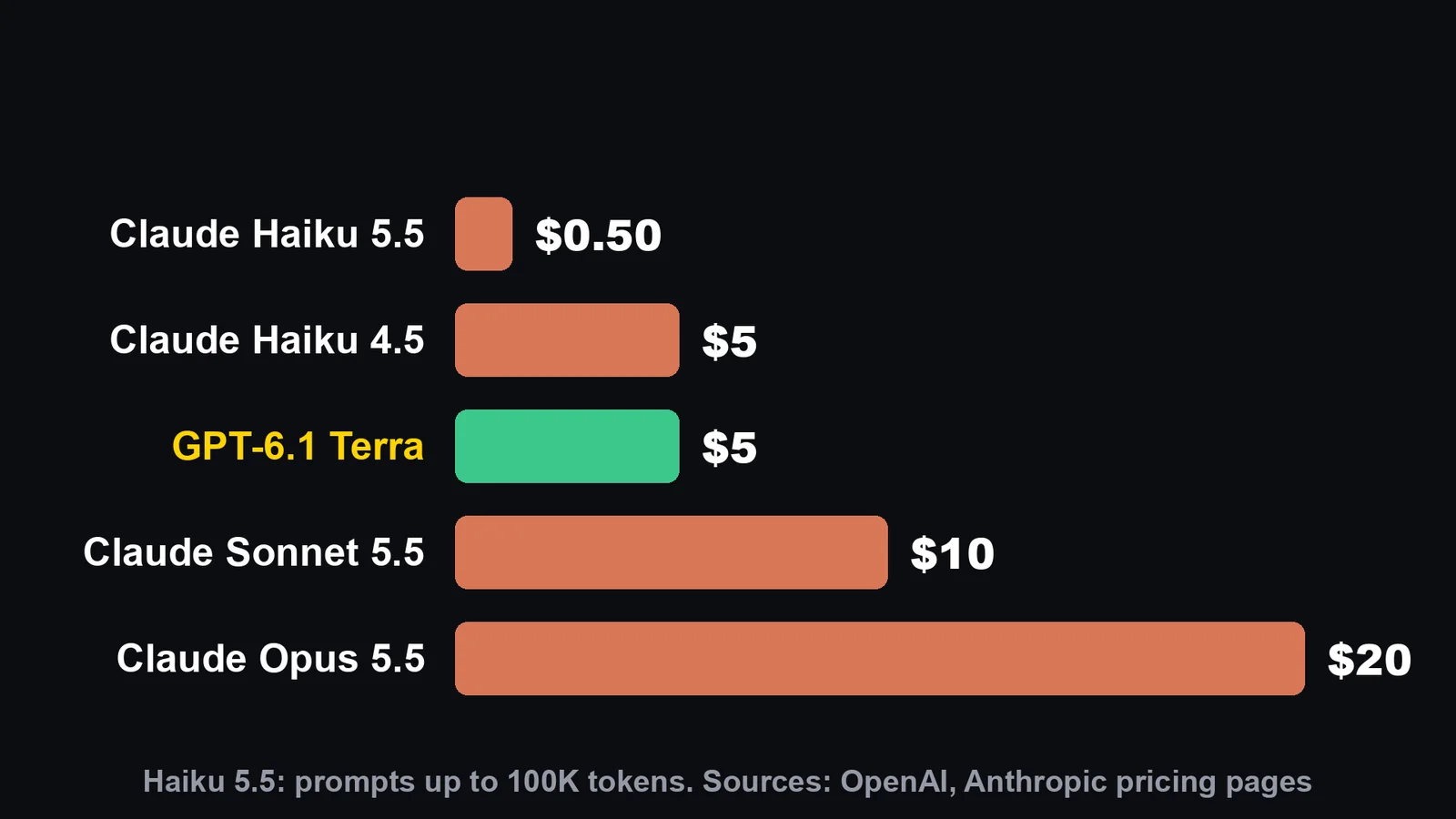
| Claude Haiku 5.5 (prompts up to 100K tokens) | $0.10 | $0.50 |
| Claude Haiku 5.5 (prompts over 100K tokens) | $0.50 | $2.50 |
| Claude Haiku 4.5 | $1 | $5 |
| GPT-6.1 Terra | $1 | $5 |
| Claude Sonnet 5.5 | $2 | $10 |
| Claude Opus 5.5 | $4 | $20 |
Two things most launch posts missed.
First, OpenAI's own "50% lower" is against its own models, GPT-5.6 Terra and GPT-6.1 Sol. It is not a claim about Claude. It just happens that Sonnet 5.5 is also $2 and $10.
Second, if you already live in Claude, the model at Terra's price is Haiku 4.5. And Haiku 5.5 is ten times cheaper than Terra. So Terra is not the cheap option. It sits between Haiku and Sonnet.
Caching changes the real bill
The price table is for fresh input. Terra also has a cache.
| Terra token type | Price per 1M tokens |
|---|---|
| Input | $1.00 |
| Cached input | $0.05 |
| Cache writes (kept 30 minutes) | $1.25 |
| Output | $5.00 |
This matters for agents. An agent session reads the same long context again and again: the files, the rules, the history.
Here is the math with the official prices. Say a session has a 100,000 token context and makes 20 calls, each writing 2,000 tokens.
- Without the cache: 20 × 100,000 = 2,000,000 input tokens = $2.00. Output 40,000 tokens = $0.20. Total $2.20.
- With the cache: one write of 100,000 tokens = $0.125. Then 19 reads of 100,000 cached tokens = $0.095. Output $0.20. Total about $0.42.
That's about five times cheaper, from the cache alone. The catch is the 30 minutes. If your agent waits longer than that between calls, it pays to write the cache again.
Claude has a prompt cache too, so this is not a Terra only discount. From Anthropic's pricing page, per million tokens:
| Model | Input | Cache write (5 min) | Cache write (1 hour) | Cache read | Output |
|---|---|---|---|---|---|
| GPT-6.1 Terra | $1.00 | $1.25 (30 min) | $0.05 | $5.00 | |
| Claude Haiku 4.5 | $1.00 | $1.25 | $2.00 | $0.10 | $5.00 |
| Claude Sonnet 5.5 | $2.00 | $2.50 | $4.00 | $0.10 | $10.00 |
The same session on Claude, with the 5 minute cache:
- Claude Sonnet 5.5: $4.40 without the cache, about $0.84 with it.
- Claude Haiku 4.5: $2.20 without the cache, about $0.52 with it.
- GPT-6.1 Terra: $2.20 without the cache, about $0.42 with it.
So with caching on both sides, Terra is still half of Sonnet. Against Haiku 4.5, the gap is small: the price list is the same, and only the cache read differs ($0.05 against $0.10). Claude's cache lasts 5 minutes by default, or 1 hour if you pay twice the input price to write it. Terra keeps it for 30 minutes.
So for agent work, compare the cached price, not just the headline price. A Hacker News post on October 27 redid the price comparison for exactly this kind of cache-heavy session.
OpenAI's charts, every setting
OpenAI published four charts that compare Terra with Claude. The video showed one number from each. Here is every point, from the data inside the charts on OpenAI's announcement page. These are OpenAI's numbers, not independent ones.
Agents' Last Exam (the AI uses a computer to do professional work)
| Model | Effort | Score | Cost per task |
|---|---|---|---|
| Claude Opus 5.5 | Max | 63.2% | $8.82 |
| GPT-6.1 Terra | Max | 60.0% | $1.01 |
| GPT-6.1 Terra | Xhigh | 58.5% | $0.66 |
| GPT-6.1 Terra | High | 57.2% | $0.39 |
| GPT-6.1 Terra | Medium | 57.6% | $0.29 |
| GPT-6.1 Terra | Low | 55.9% | $0.16 |
| GPT-6.1 Sol | Max | 58.6% | $2.00 |
| GPT-5.6 Terra | Max | 50.7% | $3.58 |
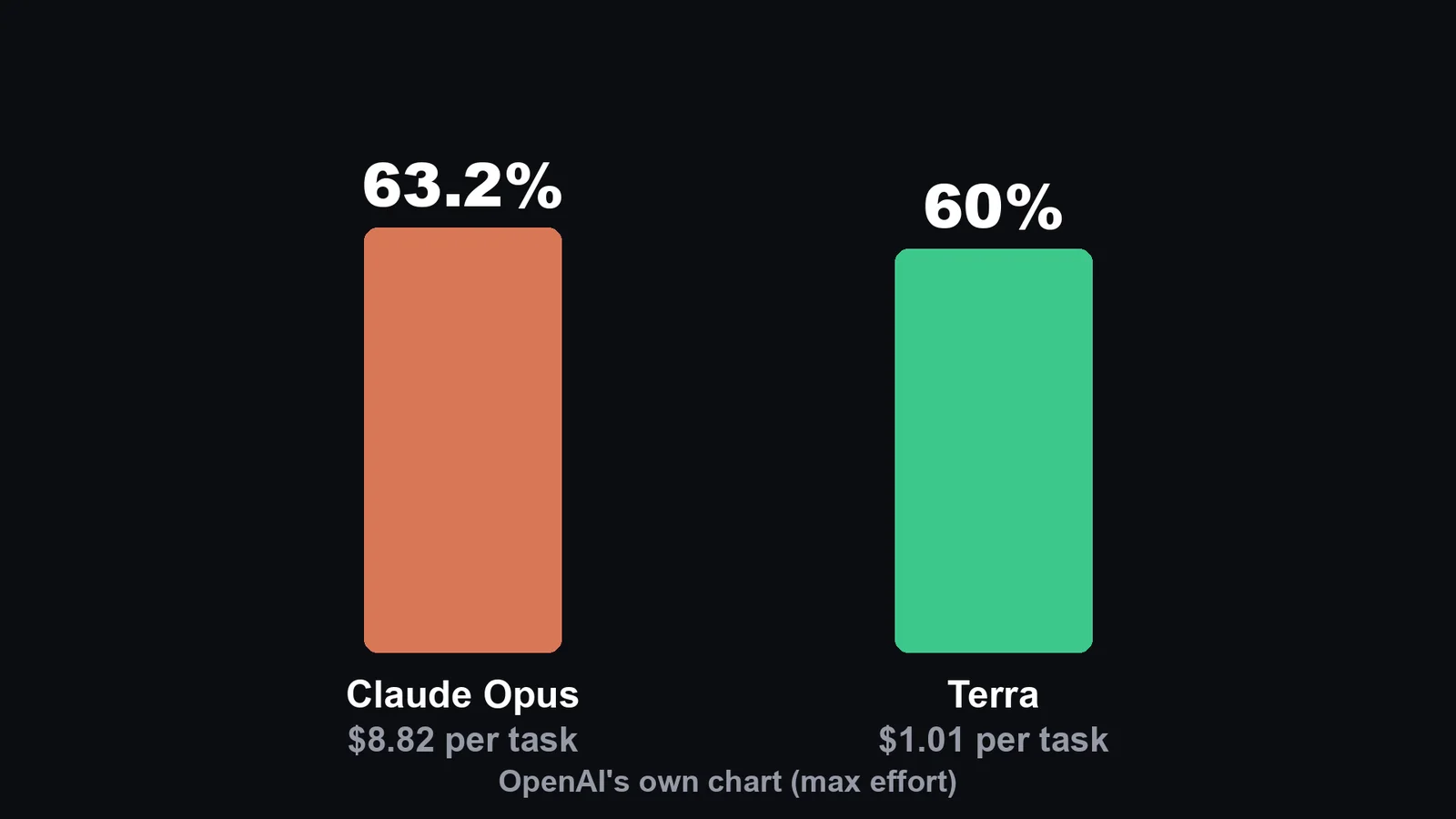
Opus still leads, by 3 points, at nearly nine times the cost. Terra at Max also beats OpenAI's bigger Sol at Max, for half the cost.
OSWorld 2.1, offline set (using desktop apps)
| Model | Effort | Score | Cost per task |
|---|---|---|---|
| Claude Sonnet 5.5 | Max | 83.9% | $5.74 |
| Claude Sonnet 5.5 | Xhigh | 81.0% | $2.22 |
| Claude Sonnet 5.5 | High | 73.3% | $1.39 |
| Claude Sonnet 5.5 | Medium | 65.9% | $0.93 |
| GPT-6.1 Sol | Max | 78.0% | $1.15 |
| GPT-6.1 Terra | Max | 74.2% | $1.19 |
| GPT-6.1 Terra | Medium | 66.7% | $0.50 |
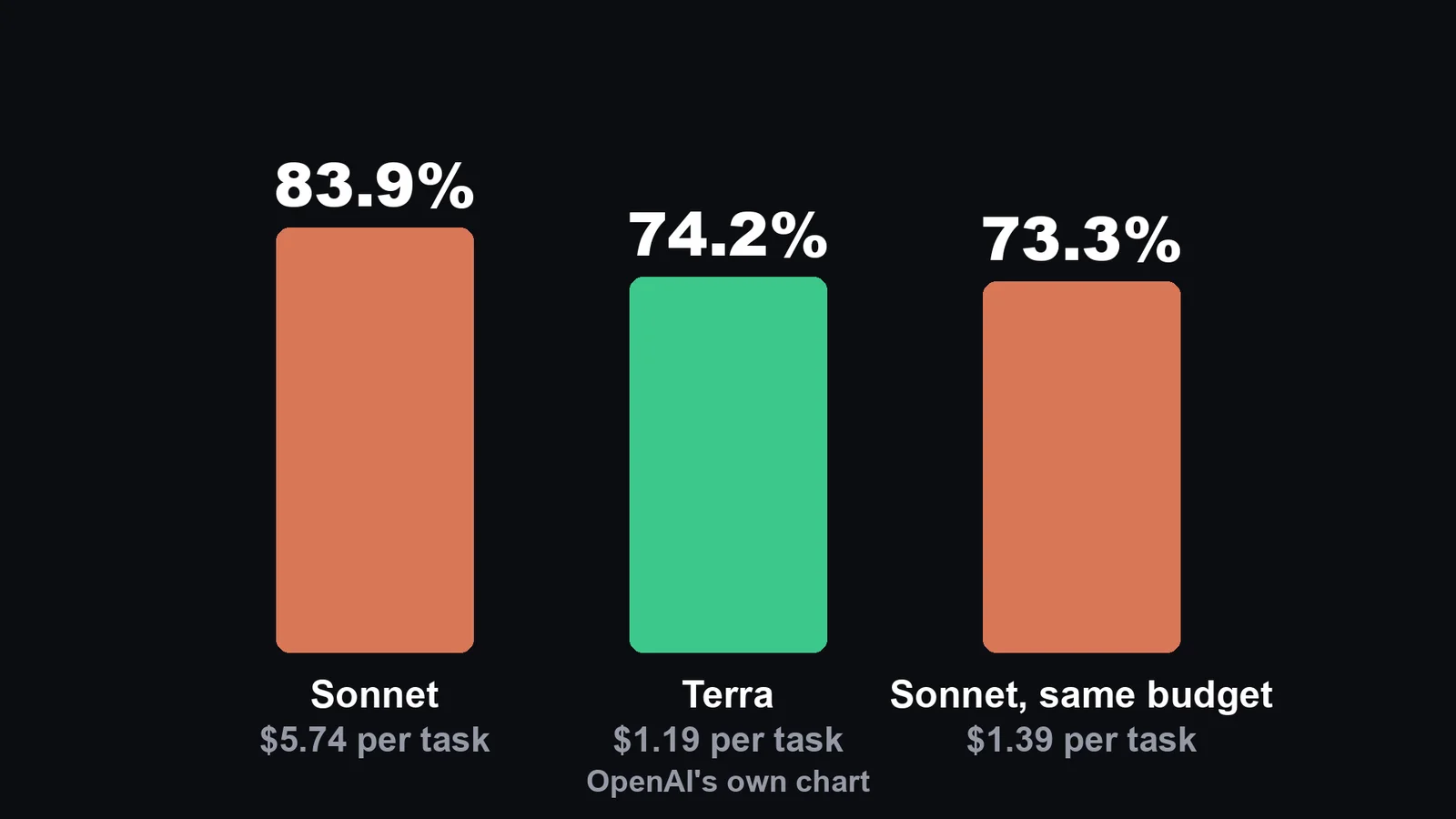
Sonnet wins at the top. At the same budget of about $1.20 to $1.40 per task, Sonnet High and Terra Max score about the same. And look at Sol: 78.0% at $1.15, a higher score than Terra Max for slightly less money. On this chart, the cheaper model is not the better deal.
Terminal-Bench 4.0 (coding in the terminal)
| Model | Effort | Score | Cost per task |
|---|---|---|---|
| Claude Sonnet 5.5 | Max | 70.6% | $10.44 |
| Claude Sonnet 5.5 | Xhigh | 61.5% | $4.34 |
| Claude Sonnet 5.5 | High | 43.0% | $1.46 |
| GPT-6.1 Sol | Max | 55.9% | $1.98 |
| GPT-6.1 Sol | Low | 47.1% | $0.76 |
| GPT-6.1 Terra | Max | 50.3% | $1.84 |
| GPT-6.1 Terra | Xhigh | 46.4% | $0.99 |
| GPT-6.1 Terra | Medium | 35.8% | $0.46 |
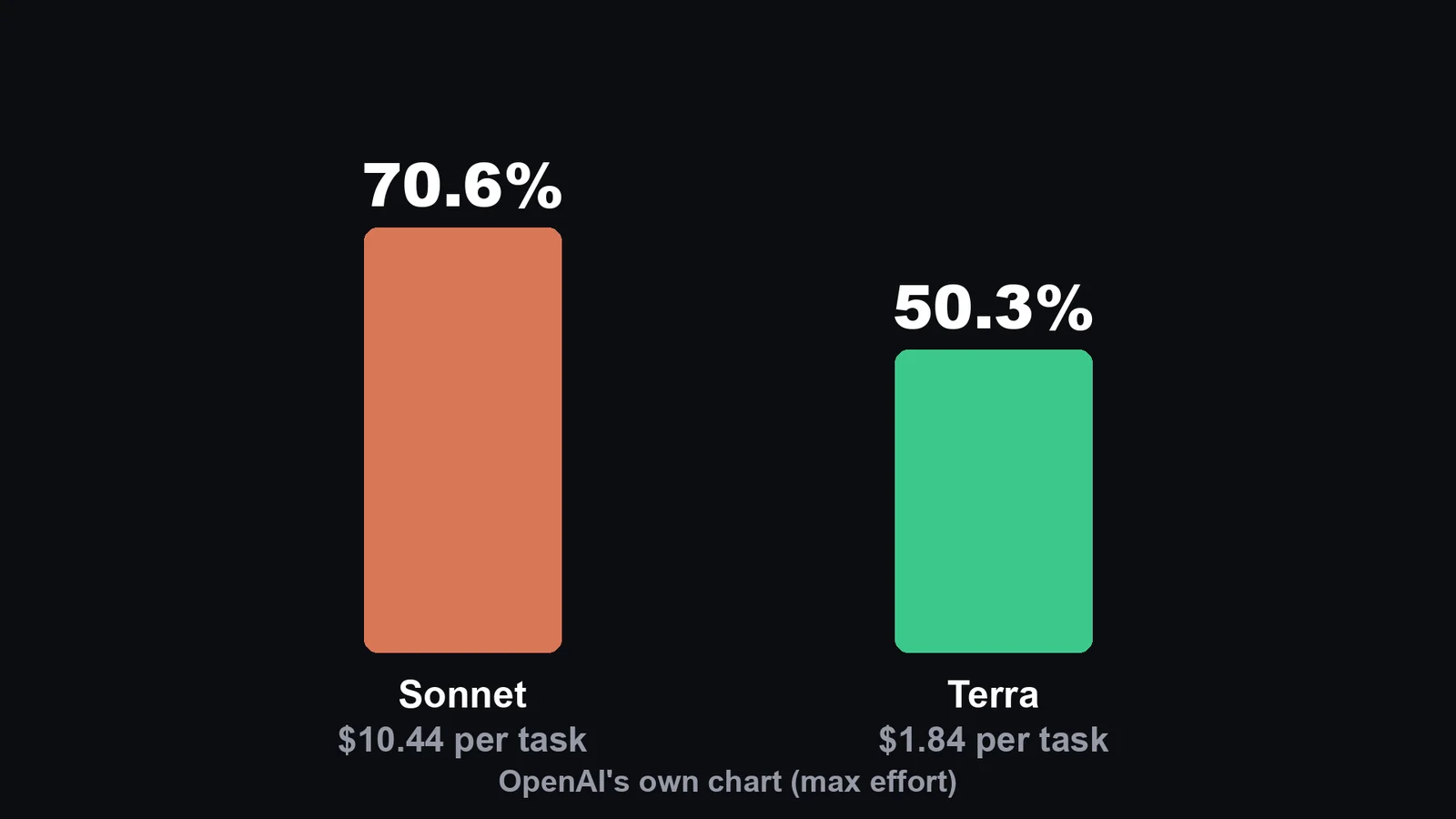
This is the one place Terra falls way behind. Sonnet at Max is 20 points ahead. Even inside OpenAI's lineup, Sol at Low (47.1%, $0.76) beats Terra at Xhigh (46.4%, $0.99). OpenAI says it plainly: "For the most complex coding tasks, GPT-6.1 Sol and GPT-6 Astra remain the better choice."
Terminal-Bench-Science 0.1
| Model | Effort | Score | Cost per task |
|---|---|---|---|
| Claude Opus 5.5 with fallbacks | Max | 63.3% | $23.21 |
| GPT-6.1 Terra | Max | 58.3% | $4.15 |
| GPT-6.1 Sol | Max | 57.0% | $5.47 |
Here Terra Max edges past Sol Max, and costs less than a fifth of Opus.
The effort setting is a second price list
The tables above show something the headline price hides. The same model costs very different amounts depending on how hard you let it think.
On Agents' Last Exam, Terra at Low scored 55.9% for $0.16 per task. At Max it scored 60.0% for $1.01. That's about six times the cost for about 4 more points. And Medium (57.6%) actually scored a little higher than High (57.2%).
On Terminal-Bench, it goes the other way. Terra climbs from 35.8% at Medium to 50.3% at Max. For hard coding, the extra thinking is worth more.
So pick the effort per job, not per model. For checks and short answers, start low and go up only if the answers get worse.
Fewer made up answers
OpenAI also published an internal test of how often the model states something wrong.
| Model and setting | Error rate |
|---|---|
| GPT-5.6 Terra, lowest effort | 53.6% |
| GPT-6.1 Terra, lowest effort | 16.7% |
| GPT-6.1 Terra, max effort | 4.3% |
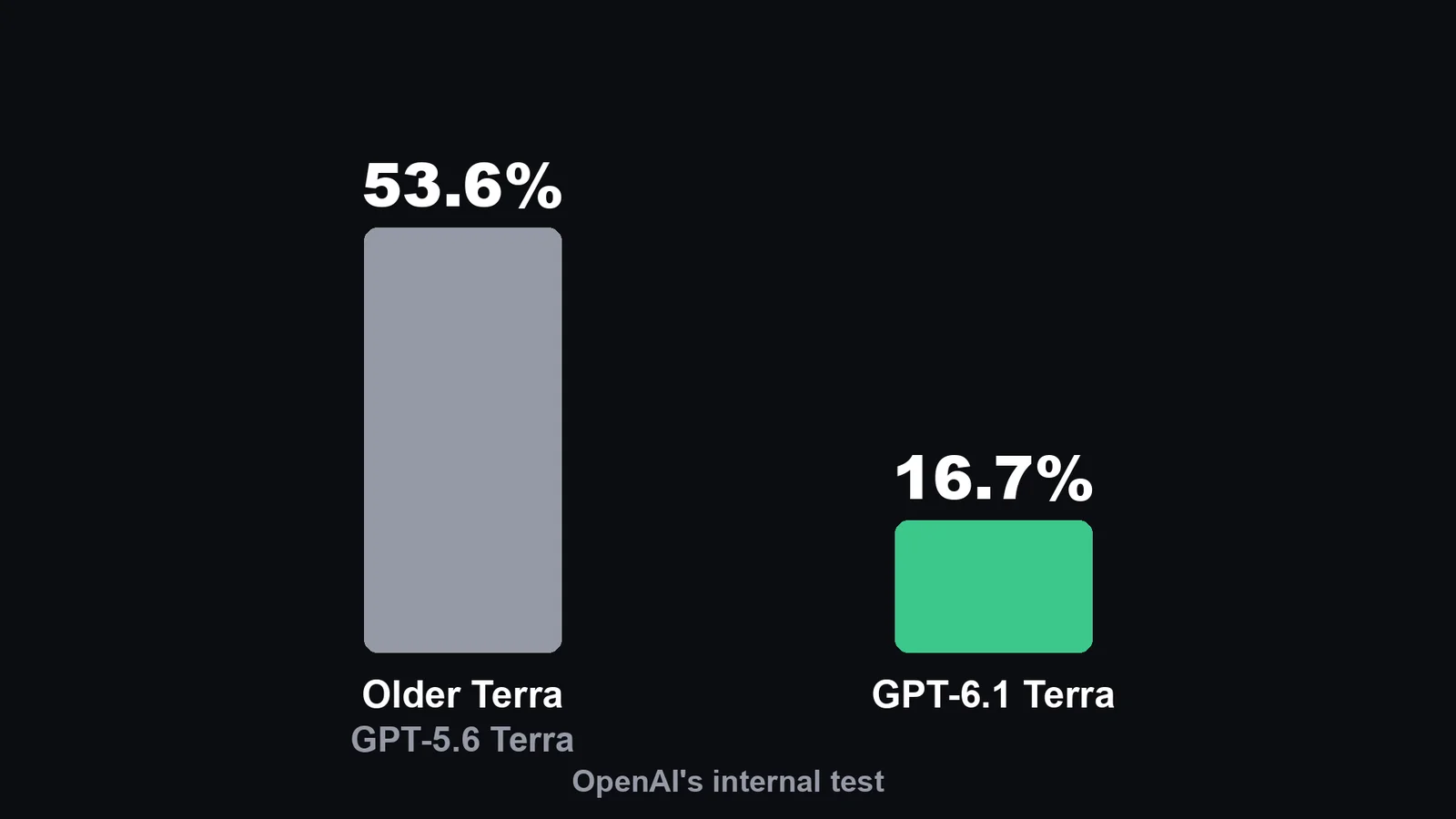
People on Hacker News called the drop "staggering". It's still OpenAI's test and OpenAI's number, with no Claude on the chart.
Independent tests
Two independent sites test every model the same way.
Artificial Analysis (read November 2, 2026)
| GPT-6.1 Terra (Max) | Claude Sonnet 5.5 (Max) | |
|---|---|---|
| Intelligence Index v5.0 | 51 | 54 |
| Rank of 59 models | 13th | 9th |
| Output speed | 106.8 tokens/s | 138.4 tokens/s |
| Cost per index task | $0.96 | $10.02 |
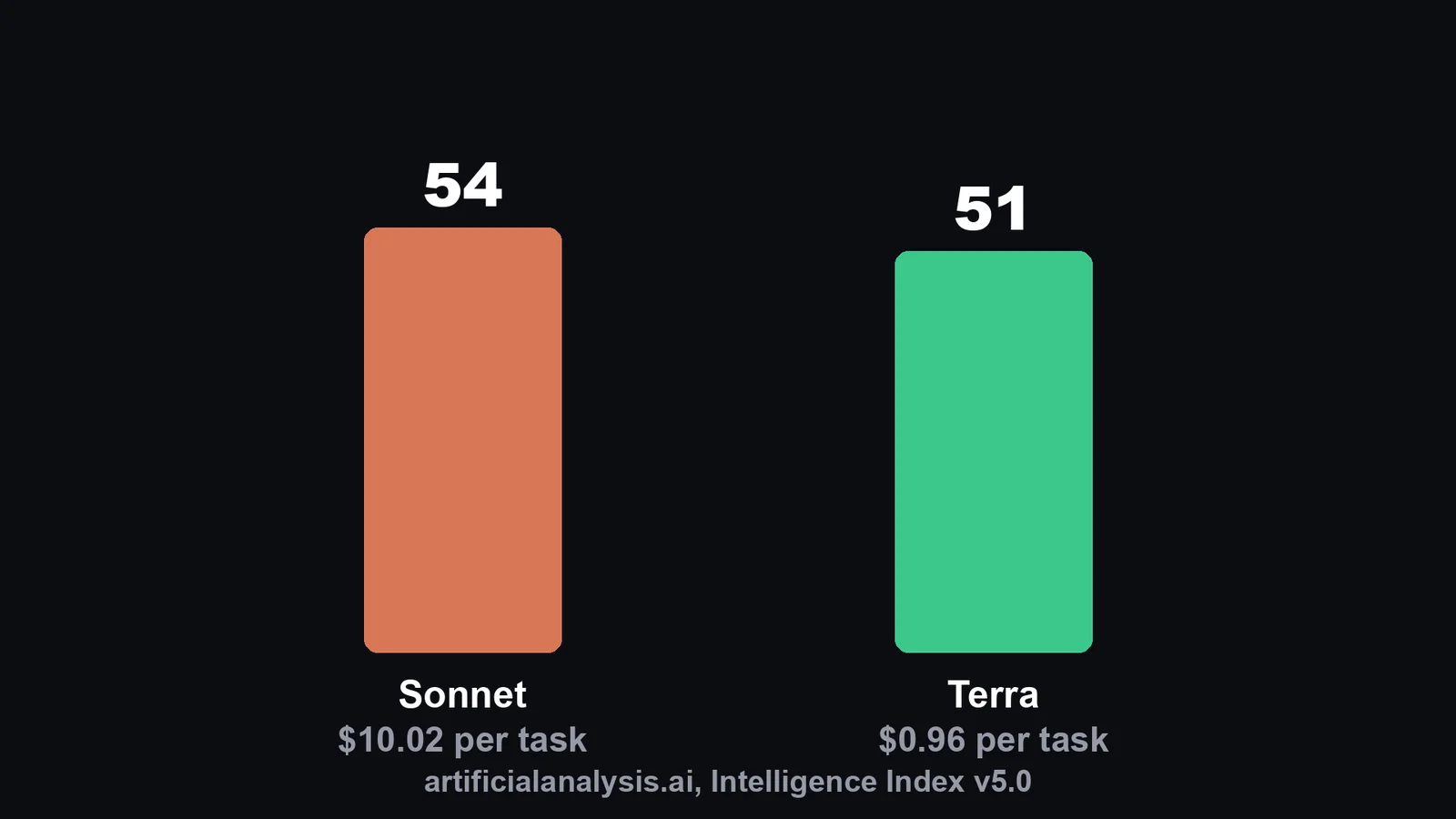
Sonnet is 3 points smarter on this index, and about ten times more expensive per task. Note the speed row: on Artificial Analysis, Sonnet writes its output faster than Terra. "Faster" in OpenAI's announcement means faster than OpenAI's own bigger models.
Vals AI
Vals ranks Terra 11th of 32 models, with a Vals Index of 60.54%. Its own Terminal-Bench 4.0 run gave 49.49%, close to OpenAI's 50.3%. And it noted something useful: on legal and tax questions, Terra "often declines to reach conclusions". If those are your questions, Terra is not your model.
What Hacker News argued about
The launch thread got 637 points and 427 comments. The main threads:
- "Can anyone give me the compelling reason for Terra and Sonnet to exist?" The argument: you can go up a tier with less thinking, or down a tier with more.
- The names. Luna, Terra, Sol and Astra confused a lot of people.
- Terminal-Bench looks weak. One comment: Terra at Xhigh costs more than Sol at Low and still does worse. The table above shows the same.
- Price against score charts are chosen by the vendor, so some called them "mostly uninformative".
- And the positive one I agree with: "This tier is what I'd actually point opencode at for PR reviews. The top models are too slow and expensive to run on every diff."
My test: 3 real jobs
Charts are charts, so I gave Terra three jobs from my own week. I gave the same jobs to OpenAI's bigger Sol, to see what you lose by going cheaper.

Setup: Codex CLI 0.164.0 on my Mac, signed in with my ChatGPT plan (not the API).
Each job ran on each model twice: effort "none" (my Codex default) and "medium" (the API default).
One run each, timed with time, including Codex startup.
Job 1: a YouTube description with chapters. The prompt:
Read the file (path to my script). It is the script for my English YouTube video (the English column is the narration). Write a YouTube description for it: exactly 5 lines of English text, then a chapters list starting at 0:00 with at least 3 chapters (estimate timestamps from the script, about 150 spoken words per minute). Do not use em dashes or en dashes. Output only the description.
The script was my previous video about the AI bubble. All four answers followed every rule: 5 lines, no dashes, 11 chapters from 0:00. The chapter times were almost the same across models. Terra at Medium added the concrete names from the script (Anthropic, CoreWeave, Tokyo). I found no factual errors. I'd paste any of them with light edits.
Terra's first line at none: "What happens to the AI tools you rely on if the bubble pops?" Sol's: "If the AI bubble pops, what happens to the tools you use every day?"
Job 2: checking an illustration. Every illustration in my videos gets checked for impossible phones and laptops: a screen on the back, a lid on the wrong side. The prompt:
This is an illustration for an Instagram carousel. Check only one thing: is the smartphone drawn correctly? The screen must face the person holding it, and there must be no screen on the back of the phone. Answer OK or NG on the first line, then explain in 2 to 3 sentences what you see.
All four answered OK and described the back of the phone with the camera facing the viewer. That's correct. I checked the drawing myself. Terra at none: "The visible side of the phone has a camera lens and no screen, so it appears to be the back."
Job 3: fixing a bug. A small script that lists the days a video is scheduled to post. It drops the last day of the range. The prompt:
Users report that the schedule printed by schedule.py is missing the last day: posting_days(start, end) should include both start and end. Find the bug, fix it in schedule.py, and run python3 schedule.py to check. Then explain the fix in one sentence.
All four fixed it and ran the script, which printed November 1 to November 7. They fixed it in two different places, and both are correct.
# Terra (none)
-    n = (end - start).days

+    n = (end - start).days + 1

# Sol (none)
-    for i in range(n):

+    for i in range(n + 1):
I ran every fixed file again myself. All four printed all seven days.
The results
| Job | Terra none | Sol none | Terra medium | Sol medium |
|---|---|---|---|---|
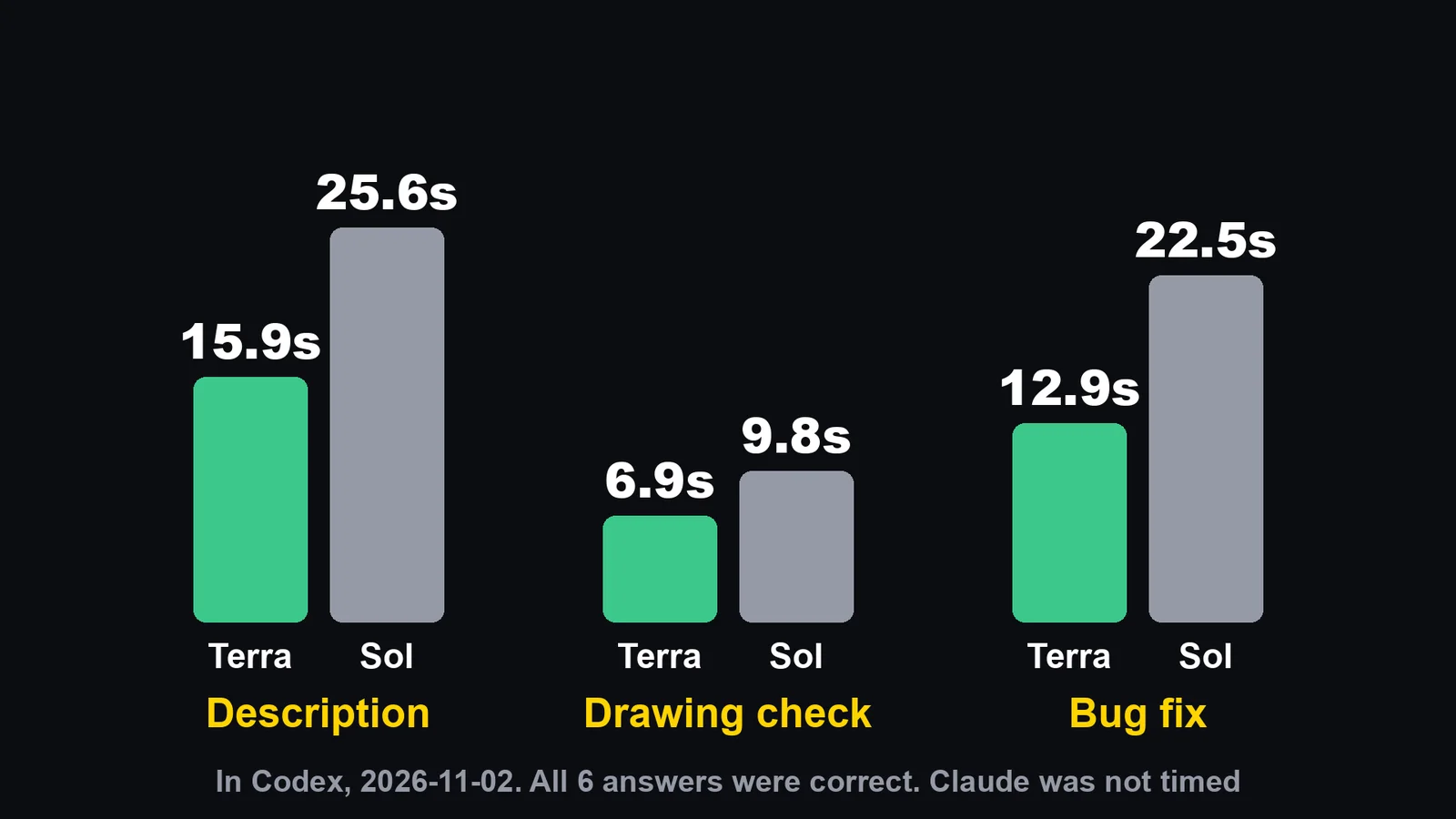
| Description | 15.9 s, 12,889 tokens | 25.6 s, 13,376 tokens | 15.4 s, 17,965 tokens | 23.6 s, 13,406 tokens |
| Drawing check | 6.9 s, 2,820 tokens | 9.8 s, 7,236 tokens | 6.9 s, 16,971 tokens | 10.3 s, 20,583 tokens |
| Bug fix | 12.9 s, 16,700 tokens | 22.5 s, 7,113 tokens | 9.7 s, 6,781 tokens | 17.1 s, 7,141 tokens |
What I read from it:
- Terra was faster than Sol on every job, 1.4 to 1.8 times. Not the "over three times" in OpenAI's announcement, but these jobs are so small that Codex startup is a big part of the time.
- Faster does not mean fewer tokens. On the bug fix at none, Terra used 16,700 tokens and Sol 7,113.
- Medium effort can multiply tokens on easy jobs. The drawing check went from 2,820 to 16,971 tokens on Terra, with the same answer.
- Quality: I couldn't see any difference. Every answer was usable.
Run the same test yourself
These are the commands I used, with Codex CLI signed in to ChatGPT.
# Job 1: text from a file
codex exec -m gpt-6.1-terra --skip-git-repo-check -C ./work "<prompt>"

# Job 2: an image
codex exec -m gpt-6.1-terra --skip-git-repo-check -C ./work -i drawing.png "<prompt>"

# Job 3: let it edit files in the folder
codex exec -m gpt-6.1-terra --skip-git-repo-check -s workspace-write -C ./work "<prompt>"

# Same job on Sol, or at another effort
codex exec -m gpt-6.1-sol ...
codex exec -m gpt-6.1-terra -c model_reasoning_effort=medium ...
Put time in front to get the seconds.
Codex prints "tokens used" at the end of each run.
What I didn't test
To be fair:
- I didn't time Claude on these jobs. So I'm not saying Terra is faster than Claude.
- I only gave it a drawing that was correct. I don't know yet if it catches a broken one.
- One run per setting. Times will move a little from run to run.
- Small jobs only. Nothing here tests the long, hard coding where Sonnet leads by 20 points.
- Codex on my ChatGPT plan shows tokens, not dollars. So I have no cost per job of my own.
Which model for which job
Am I switching? No. This is how I'm splitting the work.
| Job | Model | Why |
|---|---|---|
| Long coding across a whole project, sessions that run for hours | Claude | Sonnet leads Terra by 20 points on Terminal-Bench 4.0 |
| Small, repeated checks (drawings, formats, rules) | Terra or Haiku, low effort | Good enough, faster, cheaper. My drawing checks already go to Codex |
| Code review on every change | Terra | The Hacker News point: top models are too slow and expensive for every diff |
| Computer use on a budget | Terra Max or Sonnet High | About the same score at about the same cost per task |
| Legal and tax questions | Not Terra | Vals AI: it often won't reach a conclusion |
| Agent sessions that reread the same context | Whatever you pick, use the cache | Cached input is $0.05 instead of $1.00 on Terra |

The long, hard work stays on Claude: planning, writing code across a whole project, running for hours on my Mac. The small, repetitive checks go to the cheapest model that's good enough. Terra just made that side cheaper and faster.

And if you're on a budget and you live in Claude, check Haiku before you leave. It might already be the cheap model you're looking for.
Try it yourself in 1 hour
- Pick three jobs you do every week. Small ones.
- Give each one to two models: the one you use now, and the cheaper one.
- Run each at a low effort first. Time them, and check the answers yourself.
If the cheap one is good enough, move just that job. Not your whole setup. One job at a time.
Don't pick a team
Every few months, someone releases a model that's cheaper, faster, or smarter. If you pick a team, you'll be switching forever.

Don't pick a team. Pick the job. Then pick the model.
Sources: OpenAI's GPT-6.1 Terra announcement (October 26, 2026; benchmark numbers from the data inside its charts) and model docs, Anthropic's pricing page, Artificial Analysis and Vals AI (read November 2, 2026), and the Hacker News launch thread. Benchmarks are OpenAI's own numbers unless marked otherwise. My test: GPT-6.1 Terra and GPT-6.1 Sol in Codex CLI 0.164.0 on November 2, 2026, one run each. Claude was not timed in my test.