 Hisashi Space
November 16, 2026 · 18 min read
Claude Asks Too Many Questions? Here's How I Fixed It

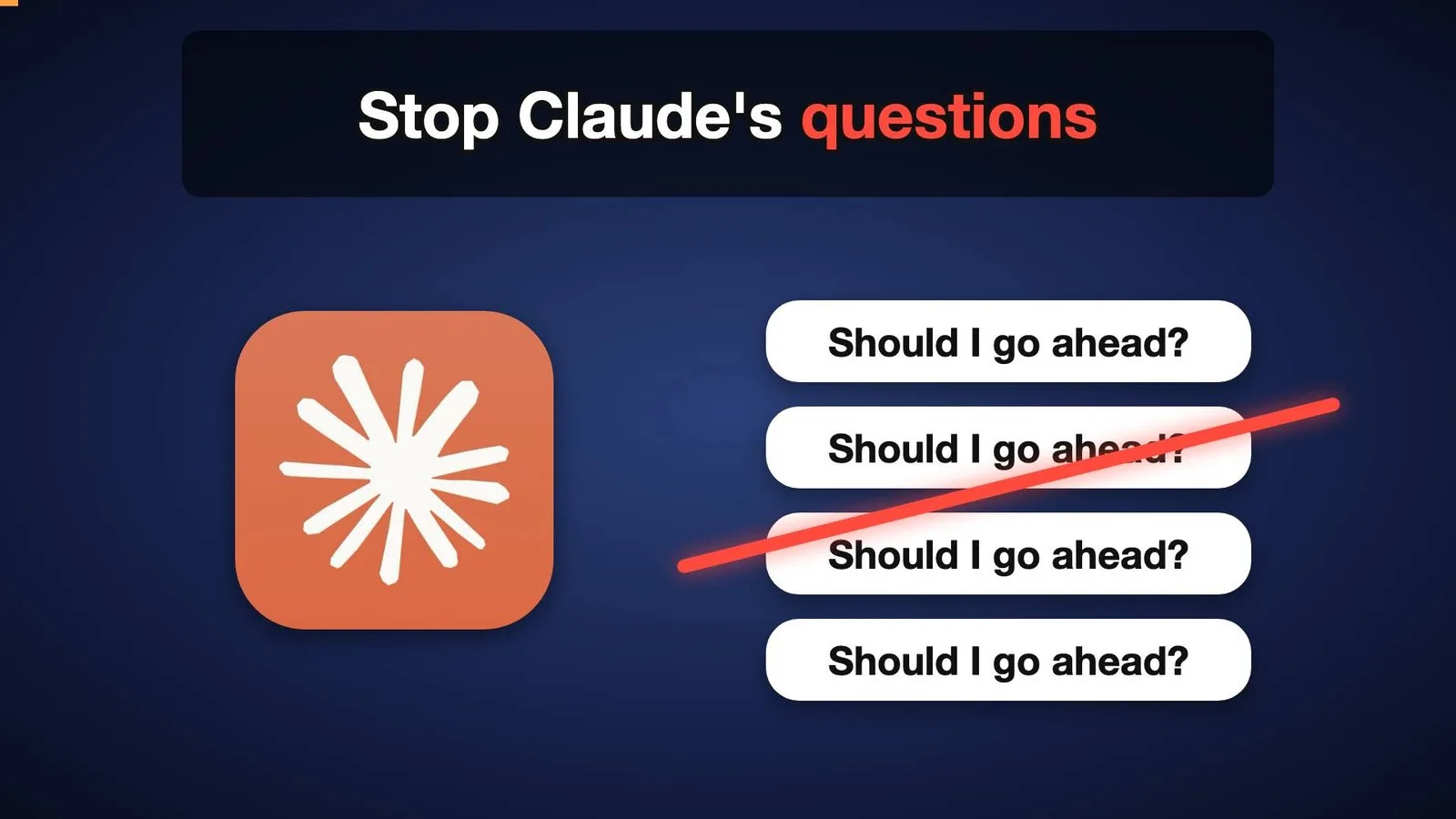
Claude asks too many questions. You give it a job, walk away, and come back to "Should I go ahead?" with nothing done.
I fixed it, and now when I come back, the work is done. I made a video about the four rules I use. This article has what the video has no room for: how this differs from the Allow pop-up, what the official docs say about why Claude suggests instead of doing and about the Stop hook, the two incidents that made me write the rules, the exact lines I put in CLAUDE.md, an English version of my two checks that I ran against sample replies, what they got wrong, and what I did not test.
The short version
- Claude does not ask because it is slow. It asks because it does not know what it is allowed to decide, so it hands every choice back to you.
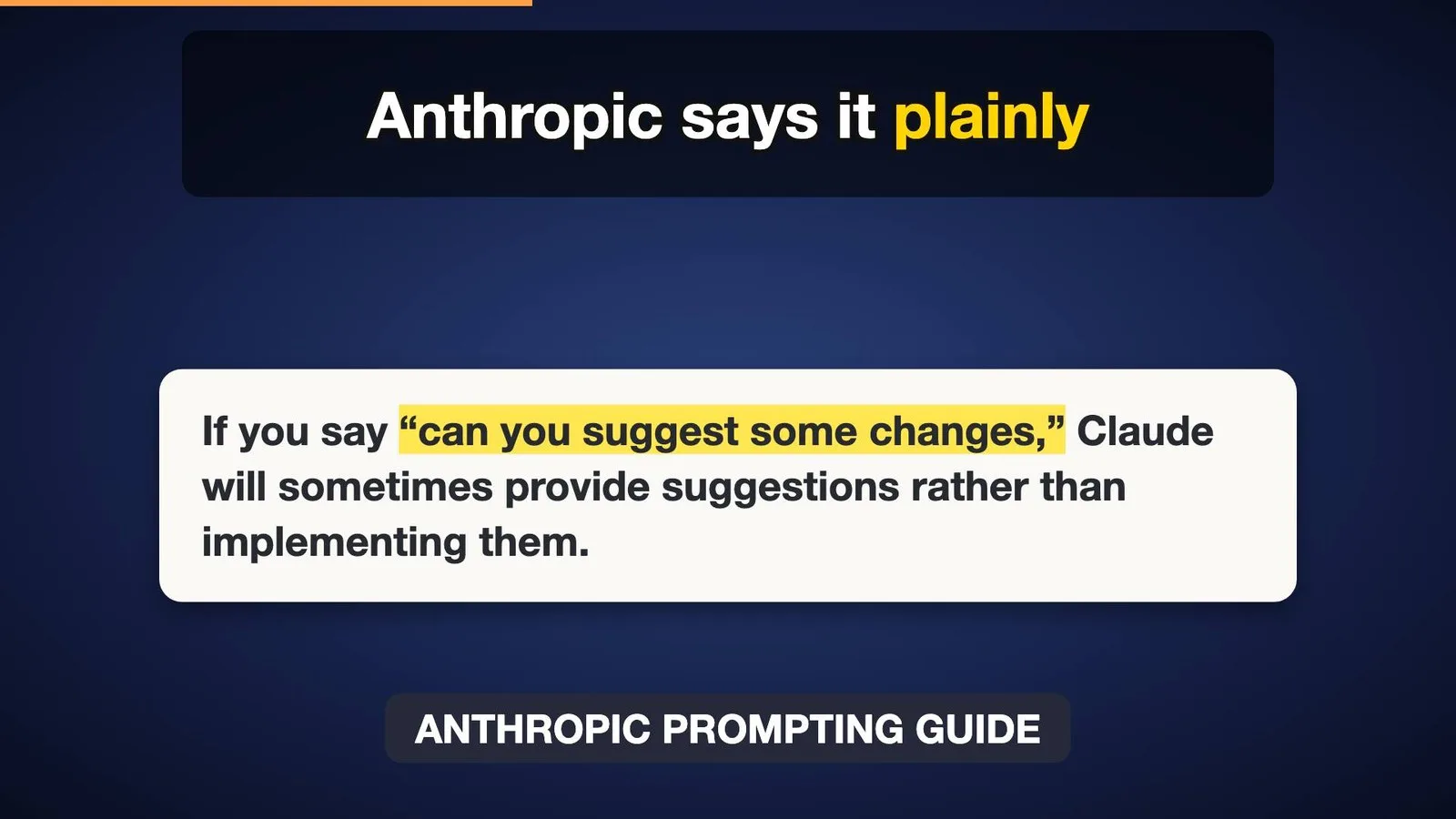
- The official prompting guide says the same thing in its own way: if you say "can you suggest some changes," Claude will sometimes provide suggestions rather than implementing them. Its fix is to say so directly, and it gives a sentence for that.
- I wrote four rules: when I say do it, finish it. I decide what, Claude decides how. Never hand the work back. And two small checks that send a bad reply back before I see it.
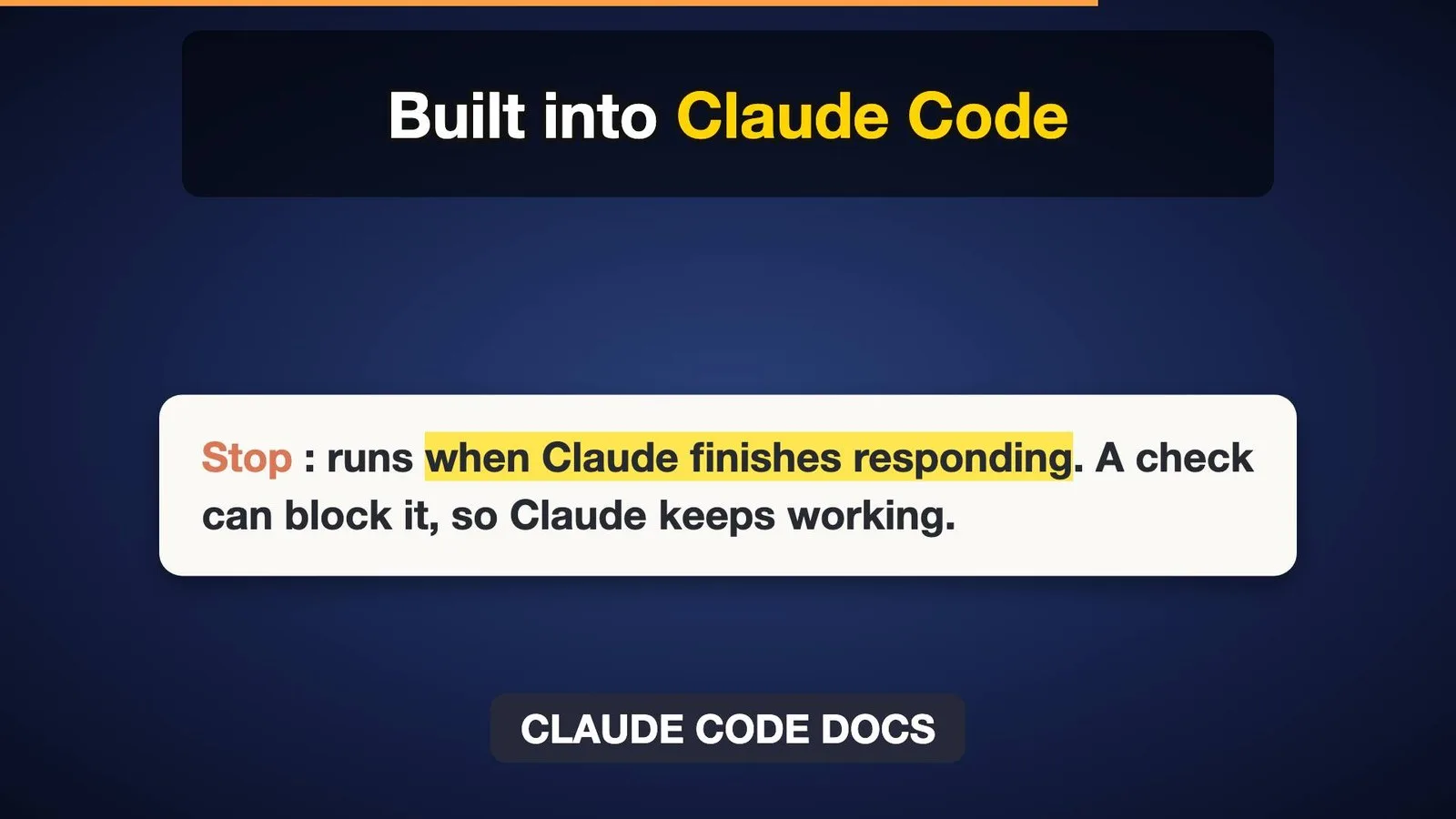
- The checks are Stop hooks. The docs say a Stop hook runs when Claude finishes responding, and that it can return a block with a reason so Claude keeps working.
- Between them, the two checks have sent back 386 replies so far. I count how in the section on the numbers.
- You can set up the basics today with four pasted sentences. No code.
I have run my own company for 22 years, and Claude Code does much of my daily work. If it stops to ask me something every time, I am not running a company. I am answering a help desk. The facts about the docs below are from pages I read on November 16, 2026. The counts are from my own conversation records, counted on November 8, 2026.
This is not the Allow pop-up
Search for this problem and most of what you find is about a different thing, so I want to separate the two first.
| Permission pop-up | A question in the chat | |
|---|---|---|
| What you see | A box: "Allow this command?" with Deny and Allow | Claude writes, in plain words, "Should I go ahead?" or "Option A or B?" |
| Where the rule lives | A list in your settings | Nowhere, which is the problem |
| What most videos teach | Turn it off (bypass permissions, auto mode) | Almost nothing |
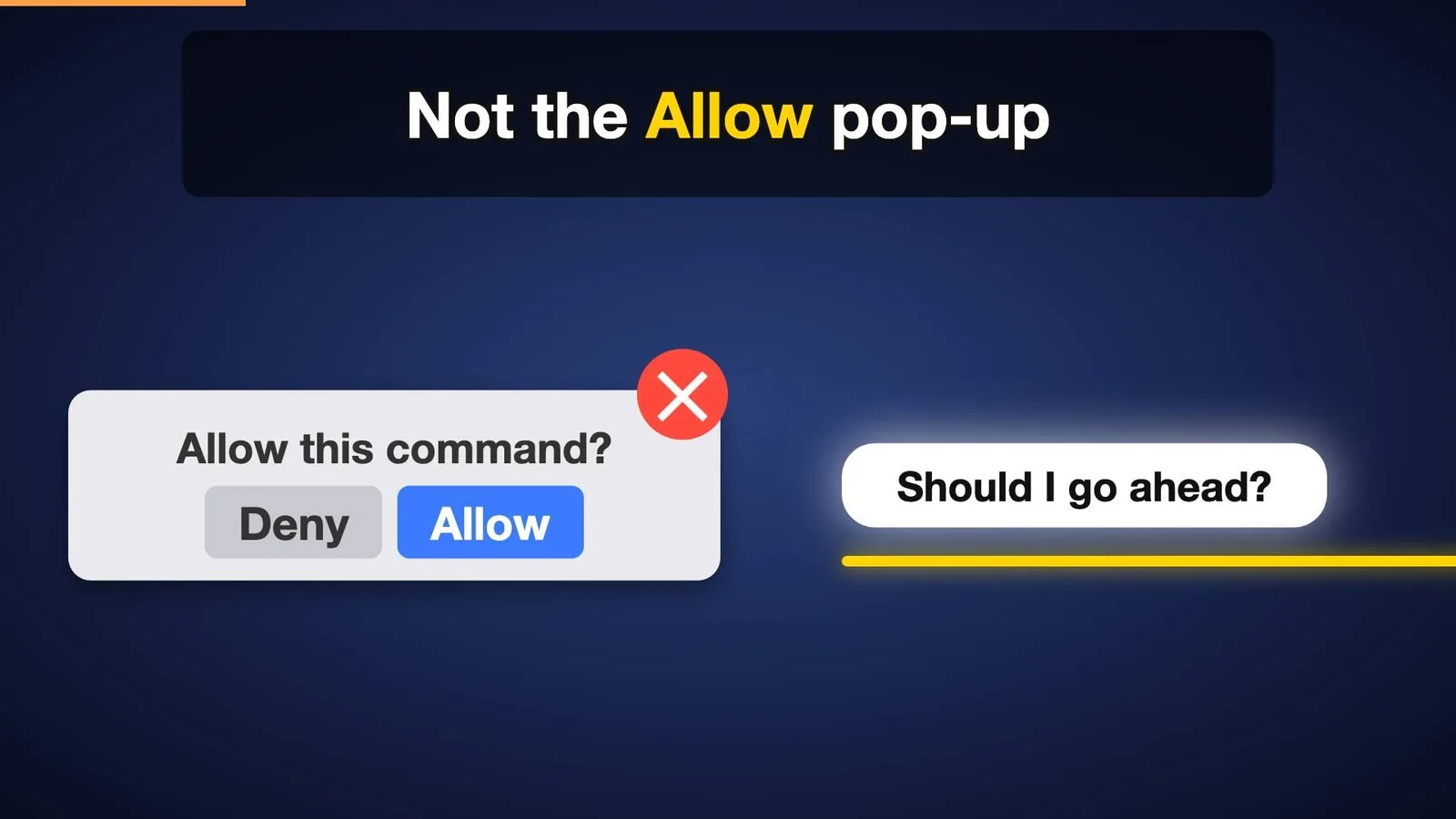
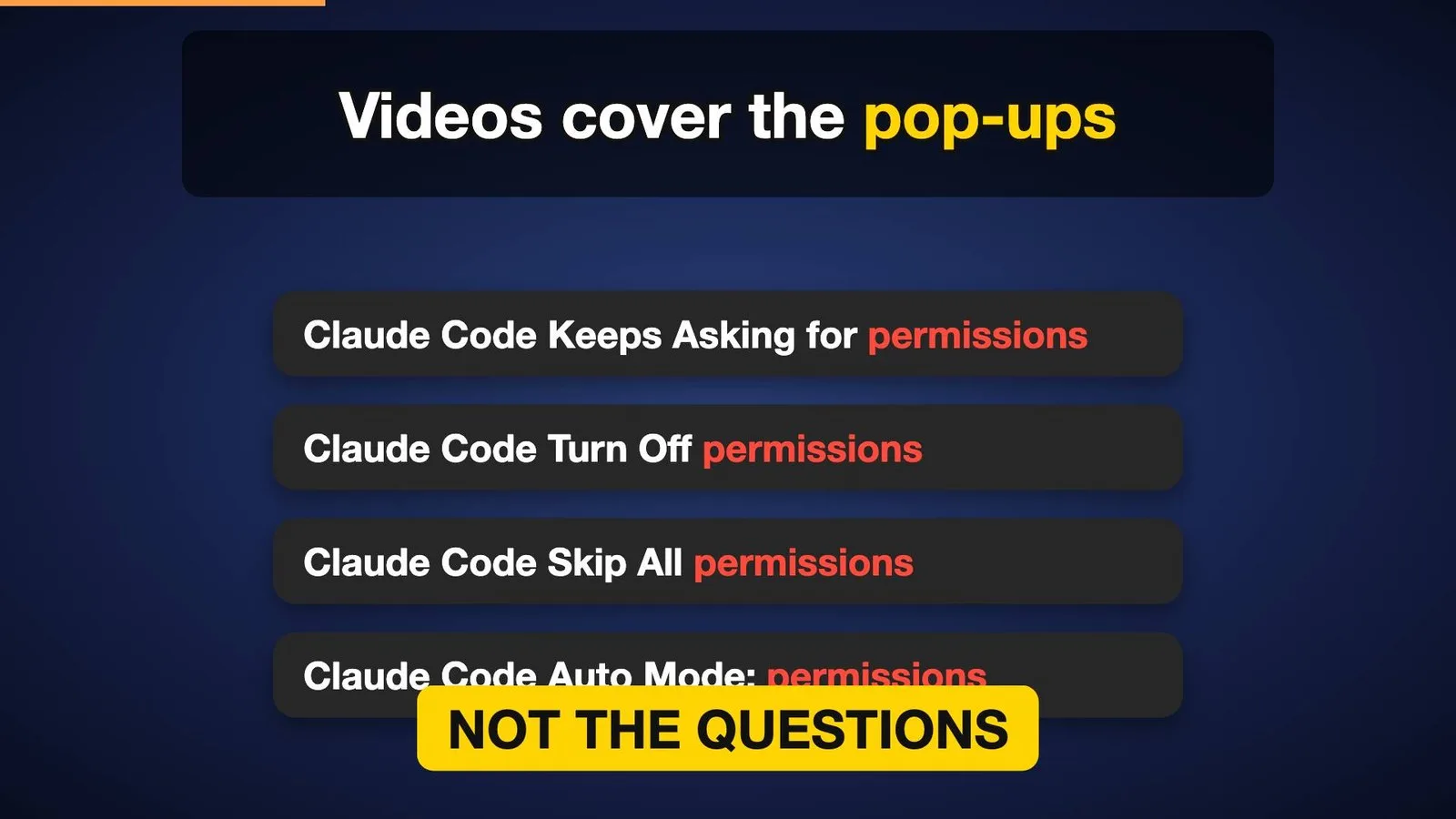
On November 11, 2026, I searched YouTube for "claude asks too many questions", "how to stop claude asking" and "claude code keeps asking". What came up was mostly about the pop-up: bypass permissions, auto mode, turn off permissions. I found no video about the questions Claude asks in the conversation.
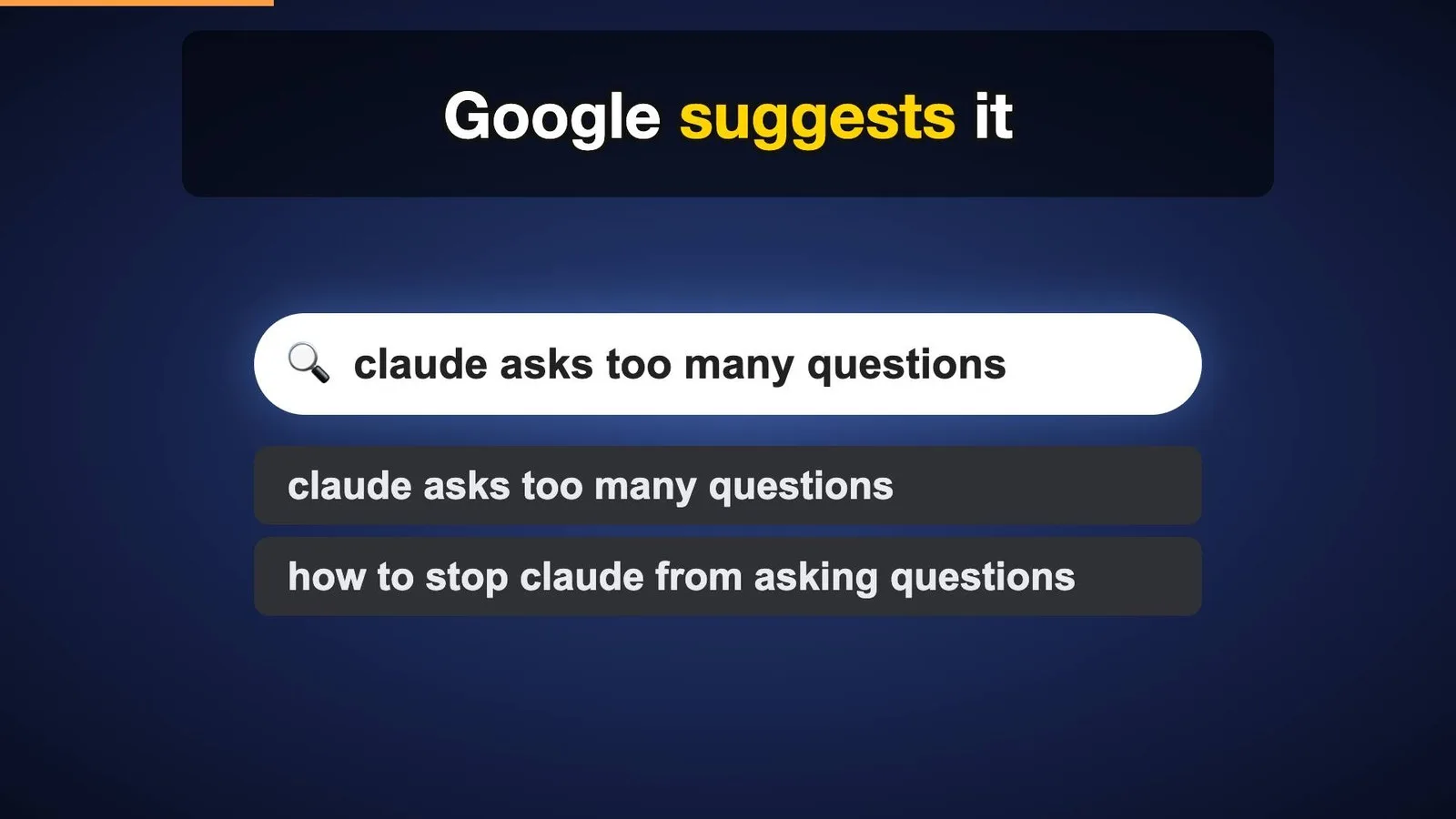
Other people feel the same thing. These are the Google suggestions I saw on November 11, 2026, with the language set to English and the country set to the US:
| I typed | Google suggested |
|---|---|
| claude asks too many questions | claude code asks too many questions, why does claude ask so many questions |
| how to stop claude asking | how to stop claude from asking questions, how to stop claude code asking questions |
| claude code keeps asking | claude code keeps asking to proceed, claude code keeps asking do you want to proceed |
| claude code stop asking | claude code stop asking to proceed, claude code stop asking for confirmation |
It is not only Claude. TechRadar ran a story headlined "I got tired of ChatGPT trying to bait me with follow-up questions after every answer". I only read the headline and the search summary, not the article.
What happened to me
Two incidents made me write the rules. Both are in my own incident records.
The first was a schedule. I had told Claude to ask the blog team to write articles, to do the shorts, and to schedule the main video. Before the blog went live, before the short was posted and before the video was scheduled, it stopped each time to ask if that was okay. The 7 a.m. schedule sat waiting for an answer until morning, and the video I wanted out never went out. I had already said yes. Looking for the cause, I found that my own CLAUDE.md said to get permission for decisions about public content. Claude applied that rule even to work I had already ordered.
The second was a hand-back. Claude wrote a script for a payment setup and told me to run it myself. When that stopped halfway, it sent me a link and asked me to change a key's permissions by hand. I told it: you do it. The same day it also asked me to pick an item from the menu bar, which it could have switched on its own.
None of this was laziness. Claude was being careful, and I had never said where careful should stop.
Why Claude asks, per Anthropic's prompting guide
Anthropic's prompting best practices page has a section on tool use. I read it on November 16, 2026. It says:
"If you say 'can you suggest some changes,' Claude will sometimes provide suggestions rather than implementing them, even if making changes might be what you intended."
The same section gives a pair of examples:
| Prompt | What Claude does | |
|---|---|---|
| Less effective | Can you suggest some changes to improve this function? | Only suggests |
| More effective | Change this function to improve its performance. | Makes the changes |
For a standing default, the page gives a sample instruction for a system prompt:
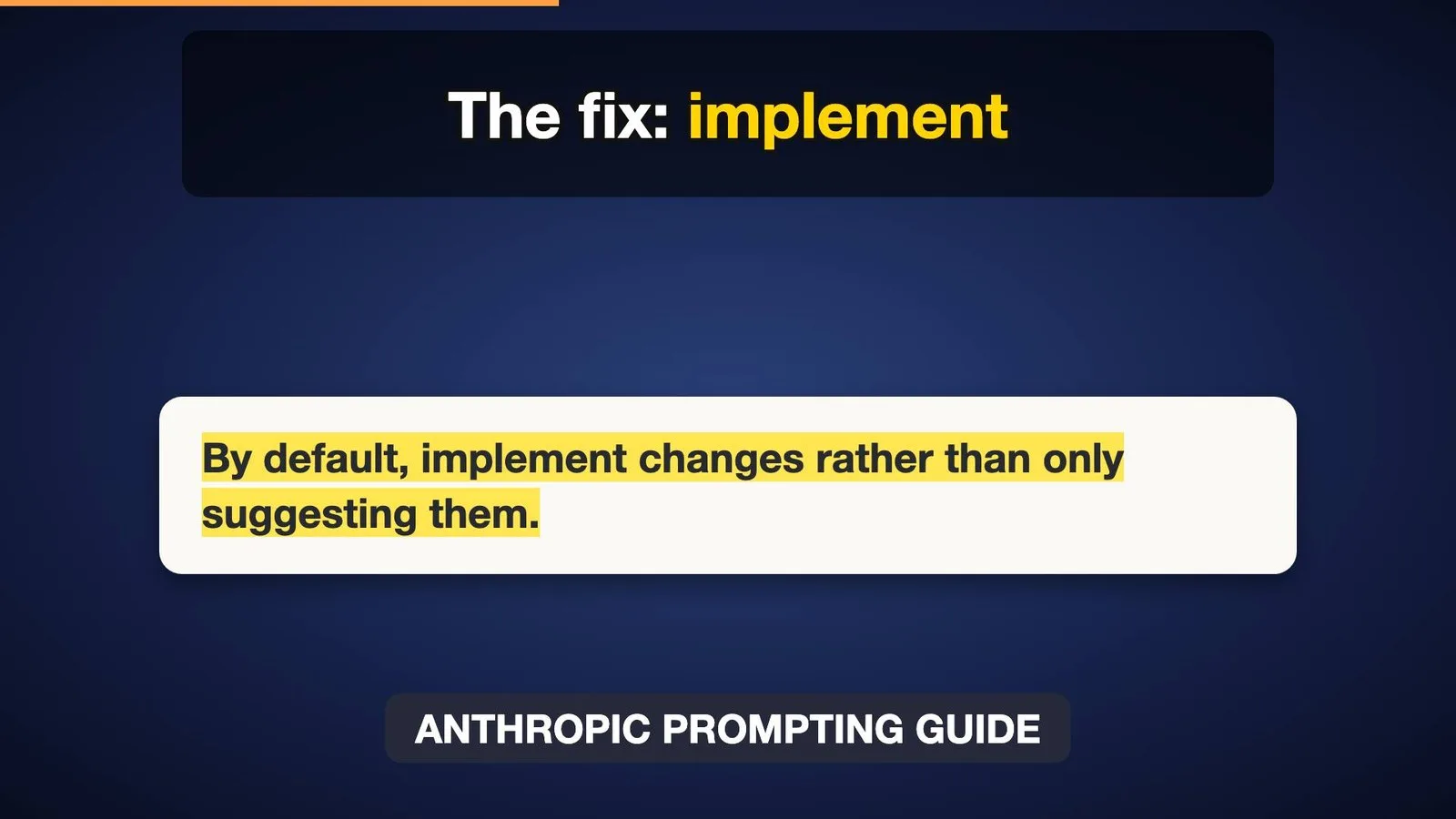
"By default, implement changes rather than only suggesting them. If the user's intent is unclear, infer the most useful likely action and proceed, using tools to discover any missing details instead of guessing."
That page is about what a prompt can do. The part I added is the idea of a job description. If you never tell a new employee what they can decide, they will check everything with you. That is not a bad employee. That is a missing job description.
Rule 1: when I say do it, finish it
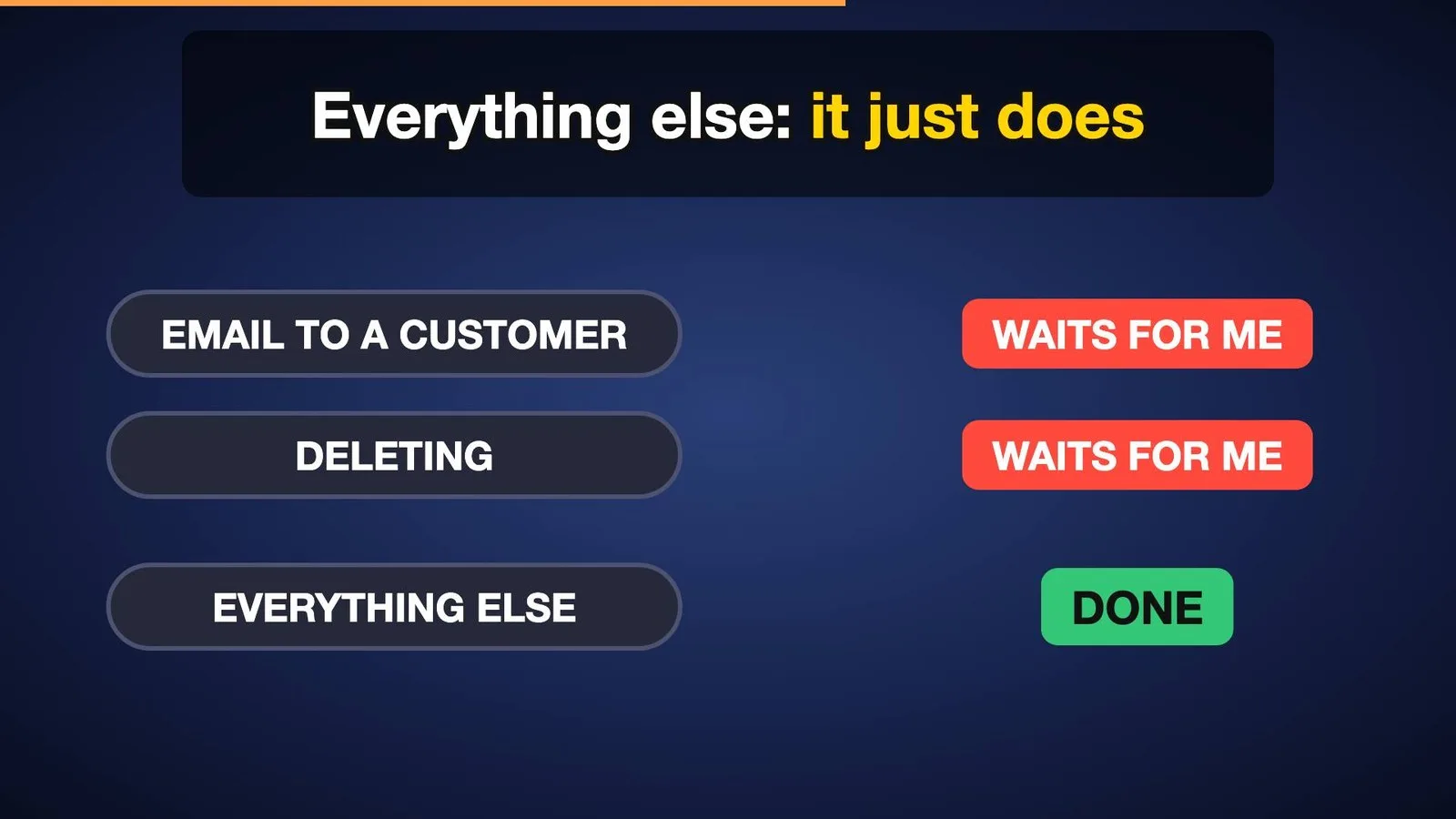
My instruction was the permission. If I have already said go, Claude does not get to ask "should I go ahead". Asking again is only a delay. It sounds obvious, but I had to write it down. In Claude Code, the note Claude reads at the start of every chat is a text file called CLAUDE.md.
The English version of the rules I use (mine are in Japanese and longer; this is written from the wording in my video):
# Working rules
When I say do it, finish it. Do not ask me again. My instruction was the permission.
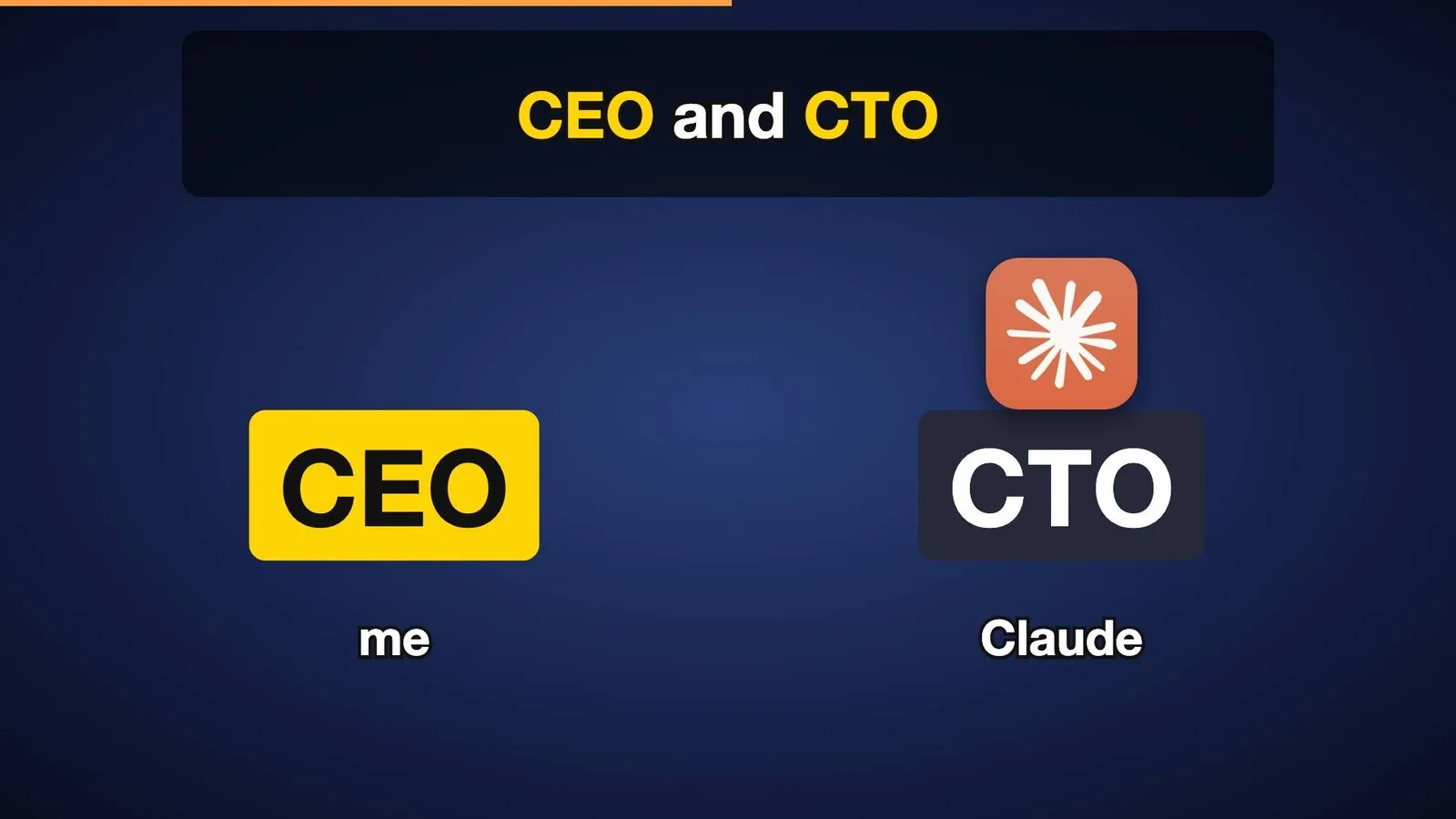
I am the CEO and you are the CTO. I decide what to build. You decide how.
Never ask me "option A or B?". Pick one and tell me: "I chose A because ..., it is done."
Ask me only about: what to build, money, anything a customer will see, anything that cannot be undone.
Never ask me to run a command or click something you can do yourself.
If you are stuck, look for another way first.
Only if you truly cannot (typing my password, picking up my phone), say why in one line starting with "Why I can't:".
One example of Rule 1 from my own file: if a development server that already exists has stopped, Claude starts it again without asking. What my file forbids is adding new infrastructure, not restarting what was already there.
Rule 2: I decide what, Claude decides how
In my note I am the CEO and Claude is the CTO, the person responsible for the technical side. So Claude cannot ask me "option A or option B?". It has to say "I chose A for this reason, and it is done."
There is a short list it must still bring to me. The video says four things:
| What stays with me | What it means in my own CLAUDE.md |
|---|---|
| What to build | Business logic and specifications |
| Money | Prices, contracts, and anything involving an amount |
| Anything a customer will see | Public content, and emails to real customers sent by hand |
| Anything that cannot be undone | Deploying to production, destructive database operations, deleting things |
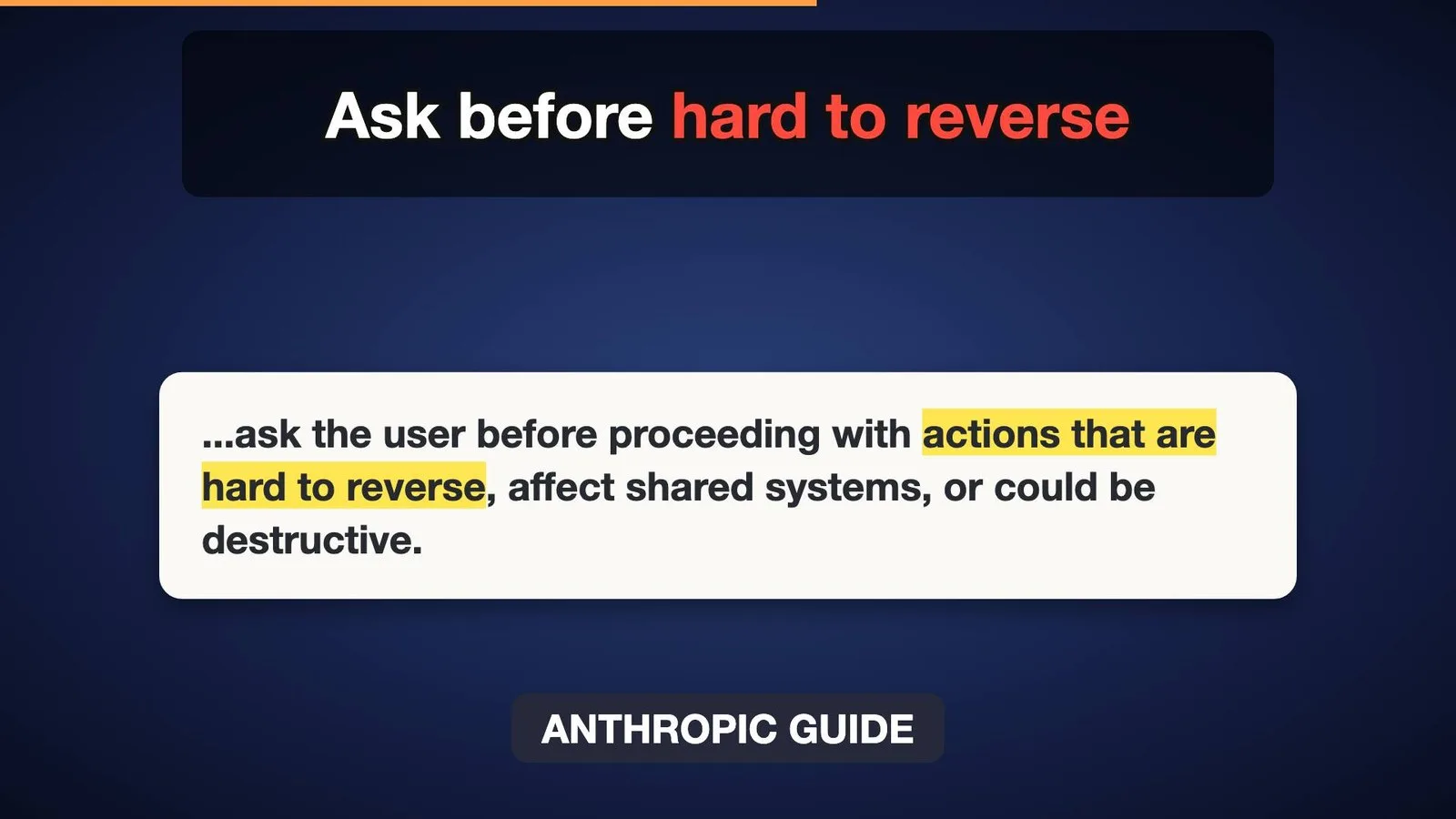
I chose a short list because I want fewer questions, not zero. Anthropic's guide draws a similar line. In its section on balancing autonomy and safety it suggests telling Claude to take local, reversible actions such as editing files or running tests, but "for actions that are hard to reverse, affect shared systems, or could be destructive, ask the user before proceeding." Its examples fall into three groups: destructive operations (deleting files or branches, dropping database tables, rm -rf), hard to reverse operations (git push --force, git reset --hard), and operations visible to others (pushing code, commenting on pull requests, sending messages, modifying shared infrastructure).
My four are not copied from the guide. They are what I picked for my own work. They do overlap with the guide's three groups, which is why I did not feel I was inventing a risky rule. So emails to real customers still wait for me. Deleting things still waits for me. Everything else, Claude just does.
Rule 3: never hand the work back
No more "please run this command". If Claude can do it, Claude does it. If it is stuck, it looks for another way first. For me, another way means a logged-in browser session, another project's .env file, a command line tool, or an API. The only exceptions are things Claude truly cannot do, like typing my password or physically picking up a phone.
Rule 4: two checks that send those replies back
This is what finally made it stick. A rule in CLAUDE.md is a request in a chat, and a request can fade as the chat gets longer. A check outside the chat runs every time.
Claude Code calls these hooks, which are small scripts that run at a set moment. Mine run when Claude finishes a reply. This is what the official hooks reference says about that moment, read on November 16, 2026:
| What the docs say | Why it matters here |
|---|---|
| The Stop event "runs when the main Claude Code agent has finished responding" and does not run if the stoppage came from a user interrupt | The check sees the reply before it reaches you |
Stop hooks receive last_assistant_message, the text of Claude's final response, and stop_hook_active |
The check can read the reply without parsing the transcript file |
decision: "block" "prevents Claude from stopping", and reason "tells Claude why it should continue" |
The reason is where you tell Claude: you were told to do this, keep going |
stop_hook_active is true when Claude Code is already continuing because of a stop hook |
Check it, so you do not block forever |
| After stop hooks have continued the turn eight times in a row, Claude Code overrides the next block and ends the turn | There is a built-in ceiling. It resets each time Claude calls a tool |
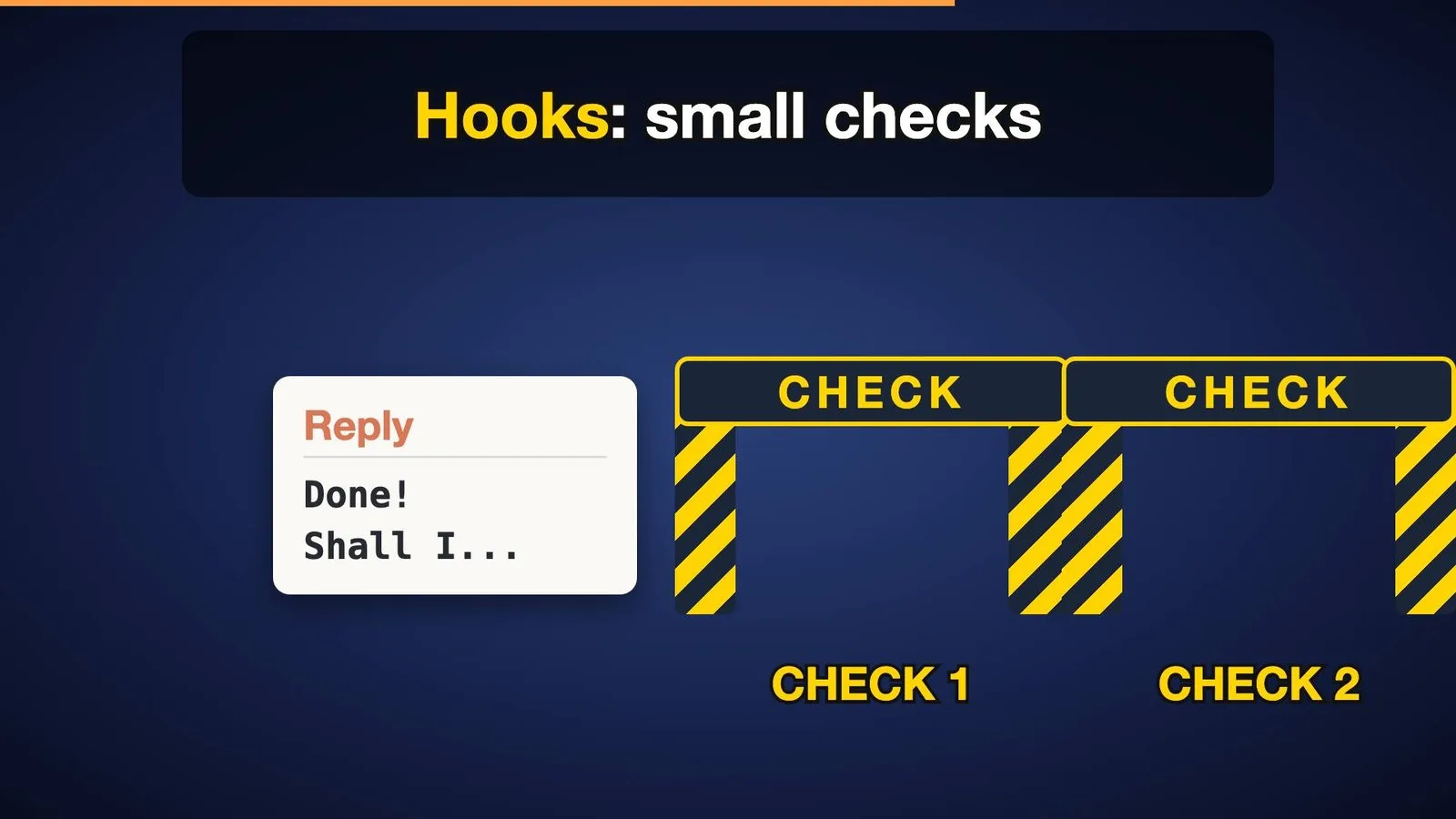
I run two checks.
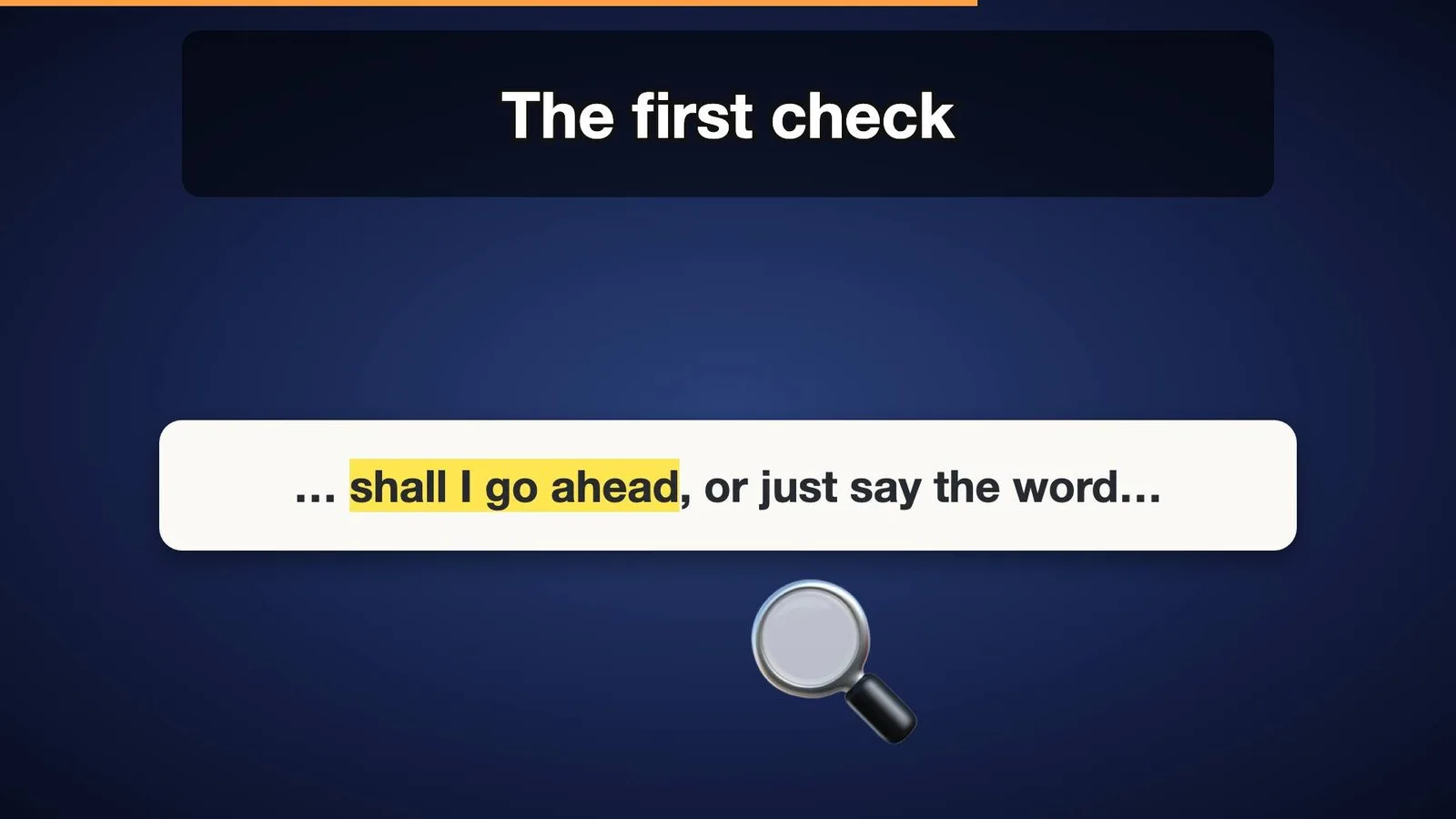
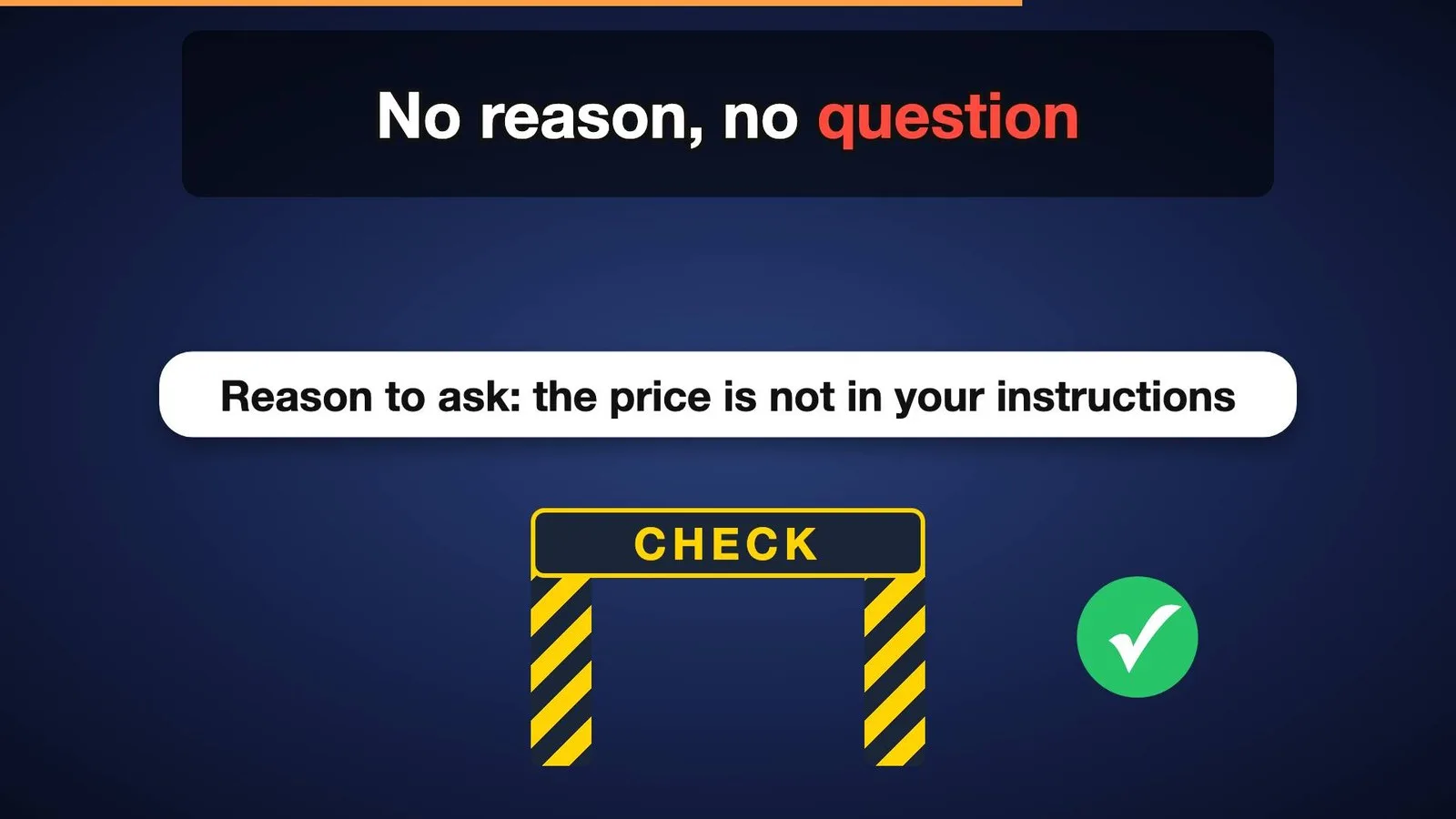
The first reads the reply for the phrases Claude uses when it asks again, like "shall I go ahead" or "just say the word". If it finds one, the reply never reaches me. Claude gets a message back: you were told to do this, so keep going. If it is truly a new decision, Claude has to write one line that starts with "Reason to ask:". No reason, no question.
The second looks for "please run this" and "please click that". It lets those through only with a line explaining why Claude cannot do it itself, one that starts with "Why I can't:".
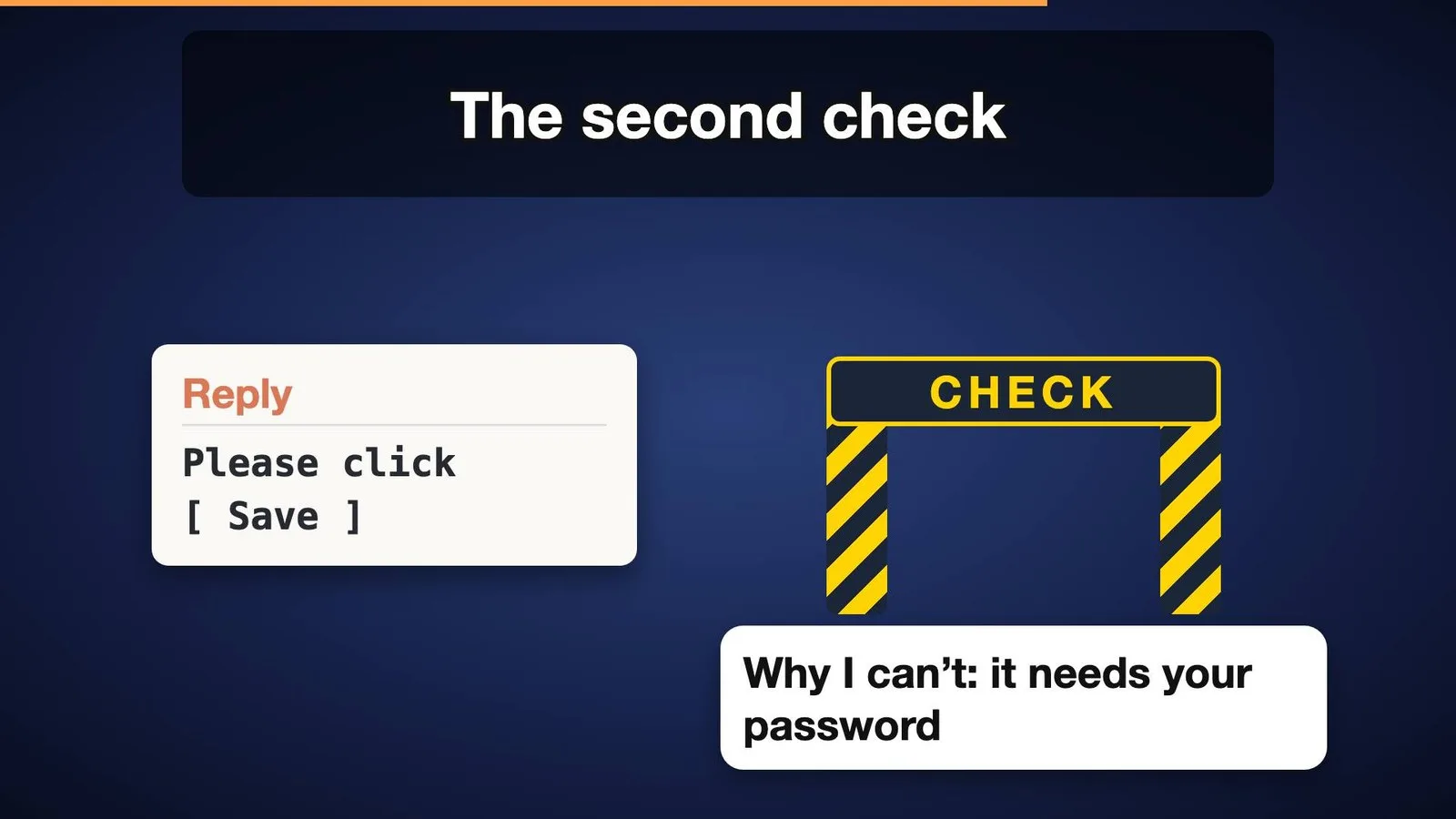
Both of mine have the same shape: read the last reply, look for phrases, skip lines that are only talking about the check itself, let it through when the required line is present, and do nothing when stop_hook_active is true. Mine match Japanese phrases, because my conversations are in Japanese.
An English version, and what I ran it against
Here is an English version of the first check. I wrote it for this article, from the shape of my real one, and ran it. The second check, for hand-backs, has the same shape and is in the setup section.
#!/usr/bin/env python3
# ~/.claude/hooks/check-reask.py
import json, re, sys

ASK = re.compile(
    r"should i (?:go ahead|proceed|continue)|shall i (?:go ahead|proceed)|"
    r"would you like me to|do you want me to|want me to|"
    r"let me know (?:if|when) you(?:'d like| want)|just say the word|"
    r"(?:option|approach) [ab] or (?:option |approach )?[ab]|"
    r"which (?:one|option) (?:do you|would you)",
    re.I,
)
REASON = re.compile(r"^\s*reason to ask:\s*\S", re.I | re.M)

data = json.load(sys.stdin)
if data.get("stop_hook_active"):
    sys.exit(0)
text = data.get("last_assistant_message", "")
hits = [l.strip() for l in text.splitlines() if ASK.search(l)]
if hits and not REASON.search(text):
    print(json.dumps({"decision": "block", "reason":
        "You are asking me again. I already told you to do this. Keep going and finish it. "
        "Only if this is a new decision (what to build, money, anything a customer sees, "
        "anything that cannot be undone), start one line with 'Reason to ask:'.\n"
        + "\n".join(hits[:5])}))
You register it in ~/.claude/settings.json. A Stop hook does not take a matcher:
{
  "hooks": {
    "Stop": [
      {
        "hooks": [
          { "type": "command", "command": "python3 \"$HOME/.claude/hooks/check-reask.py\"" }
        ]
      }
    ]
  }
}
I did not run this inside a live Claude Code session. I fed both scripts the JSON that the docs describe, as sample replies, and read what they printed. These are the 11 replies I wrote first:
| Check | Sample reply | Result |
|---|---|---|
| Asking again | "Done. ... Should I go ahead and deploy it?" | Sent back |
| Asking again | "I chose option A because it is faster, and it is finished." | Passed |
| Asking again | "Reason to ask: the price is not in your instructions. / Should I go ahead with $29?" | Passed |
| Asking again | "The migration is written. Want me to run it?" | Sent back |
| Asking again | "Done. Tests pass. Let me know if you'd like changes." | Sent back |
| Asking again | "All done. Deployed and checked the page." | Passed |
| Hand-back | "Script is ready. Please run ./deploy.sh and tell me what you see." | Sent back |
| Hand-back | "Why I can't: it needs your password. / Please enter it in the dialog." | Passed |
| Hand-back | "I ran the deploy myself and checked the page. Everything works." | Passed |
| Hand-back | "Please click Save in the settings page." | Sent back |
| Hand-back | "I opened the page, clicked Save, and checked that it stuck." | Passed |
All 11 came out as I expected. That proves little, because I wrote the replies after the scripts. So I tried to break them, and I am leaving what I found in:
| Sample reply | Result | What it shows |
|---|---|---|
| "I did not need to ask whether you want me to continue, so I kept going." | Sent back | A reply that only mentions the phrase is blocked |
| "Finished. The page asks users: Do you want me to remember you?" | Sent back | A quoted question is blocked |
| "Done. Anything else, just say the word." | Sent back | Politeness at the end of a finished job is blocked too |
| "Shipped. Should we revisit the pricing page next week?" | Passed | A real question in a slightly different wording gets through |
| "Fixed. You can run npm test yourself if you like." | Passed | The hand-back check misses this form |
So the English versions are a starting point. My real ones skip lines that talk about the check itself, and the quoted-question case would still need work. The 8-continuation ceiling in the docs also means a check like this cannot loop forever, even when it is wrong.
With stop_hook_active set to true, the script does nothing. I confirmed that too: the first sample, which is normally sent back, passed.
The numbers: 180, 206 and 386
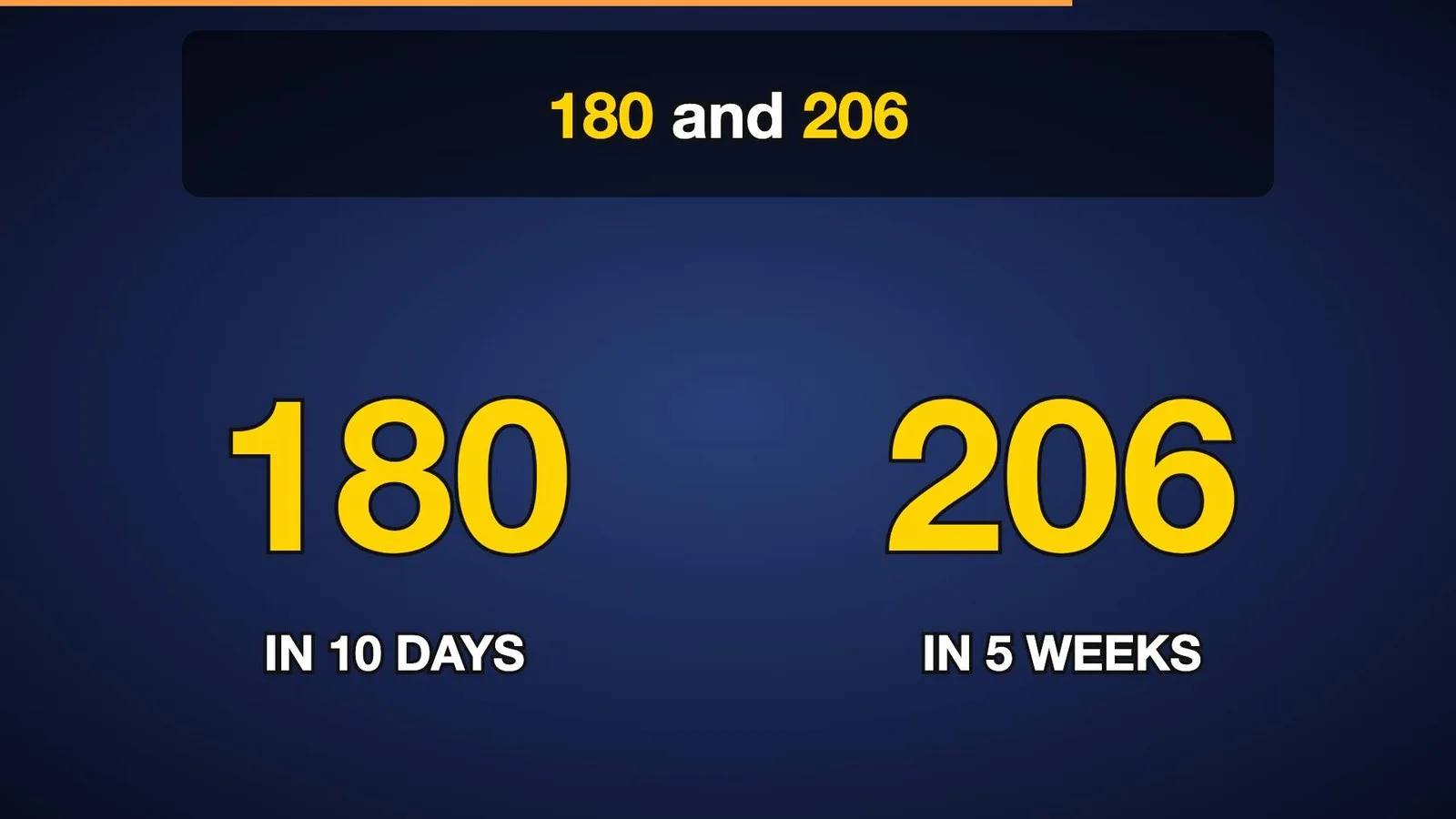
Claude Code keeps a record of each conversation under ~/.claude/projects/, as .jsonl files. When a Stop hook sends a reply back, the record holds a line that starts with "Stop hook feedback:" followed by my message. On November 8, 2026, I collected those lines, removed duplicates by each line's uuid, and counted by the wording of each check.
| Check | Count | Oldest in the records |
|---|---|---|
| The first, asking again | 180 | October 29, 2026 at 23:33 UTC (October 30, 08:33 in Japan) |
| The second, handing back | 206 | October 1, 2026 at 14:18 UTC |
| Together | 386 |
That is about 19 a day for the first check and about 5 a day for the second, my own division of those counts by the days since the oldest line. Conversation records that were deleted are gone, so these are minimums. The video says "more than 380" for the total.
Why not just turn off the prompts, or write "never ask me"
Two shortcuts look tempting.
- Turning off the prompts removes the guard. It does not teach Claude what is yours to decide.
- "Never ask me questions" is too blunt. I still want to hear about money and customers. I chose a short list because I want fewer questions, not zero.
And a request in a chat can fade as the chat gets longer. The checks run every time.
Set it up today
You do not need to write code. Open Claude Code and say these, one at a time. They are also in the description of my video.
- "Add a rule to my CLAUDE.md. When I say do it, finish the work. Don't ask me again."
- "Add: only ask me about what to build, money, anything a customer will see, and anything that can't be undone. For everything else, decide, and tell me your reason and the result."
- "Add: never ask me to run a command or click something you can do yourself."
- "Add a check to my settings file that sends back any reply asking should I go ahead. If it's a new decision, let it through only with a line starting 'reason to ask'."
Your settings file is settings.json, in the .claude folder inside your home folder. Claude adds the check there for you.
If you want the hand-back check too, ask for it the same way, and have it let a reply through only with a line starting "Why I can't:". This is the English version I ran, in the same shape as the first:
#!/usr/bin/env python3
# ~/.claude/hooks/check-handoff.py
import json, re, sys

REQ = re.compile(
    r"\b(?:please|you(?:'ll| will)? (?:need to|have to|should)|can you|could you)\s+"
    r"(?:run|click|press|type|paste|open|enter|select|set|change|install|log ?in)\b|"
    r"^\s*run (?:this|the following)|^\s*(?:click|press) ",
    re.I | re.M,
)
REASON = re.compile(r"^\s*why i can'?t:\s*\S", re.I | re.M)

data = json.load(sys.stdin)
if data.get("stop_hook_active"):
    sys.exit(0)
text = data.get("last_assistant_message", "")
hits = [l.strip() for l in text.splitlines() if REQ.search(l)]
if hits and not REASON.search(text):
    print(json.dumps({"decision": "block", "reason":
        "You are handing work to me. Do it yourself first (CLI, API, config files). "
        "Only if you truly cannot (typing my password, physically holding my phone), "
        "add one line starting with 'Why I can't:'.\n" + "\n".join(hits[:5])}))
Then test it. Give Claude a small job, and tell it to ask you for confirmation before it finishes. Watch the check send that reply back. Start with small, safe jobs. Once you trust it, give it bigger ones, and keep the short list exactly as it is.
What I did not test
- I did not run the English versions of the checks inside a live Claude Code session. I fed them sample replies in the JSON shape the docs describe and read the output.
- My real checks match Japanese phrases. I did not compare them with the English ones on real conversations.
- I did not measure how many of the 386 replies were sent back wrongly. A quoted or mentioned phrase is blocked by the English versions, and I did not count that for my real ones.
- I did not measure how much time the rules saved. I have no before and after.
- Older conversation records were already deleted, so the counts are minimums, and I did not recover them.
- I only read the headline and the search summary of the TechRadar story, and I did not read the article.
- I did not check the pages for other Claude models or settings. The docs facts are the ones in the table above.
- This is about Claude Code. I did not test the rules in the Claude chat apps.
Who this is not for
- If you want to approve every step yourself, keep the questions. This is for people who give a job and walk away.
- If Claude is stopping on the Allow pop-up and not in the chat, that is a different setting, and this article is not about it.
- If your work has no money, customers or irreversible steps, you may not need the short list at all.
So, why does Claude ask so many questions? Not because it is slow. Because you never told it what is yours to decide. Tell it, and it will finish the work.
Sources:
- Anthropic, Prompting best practices, sections on tool use and on balancing autonomy and safety (platform.claude.com/docs/en/build-with-claude/prompt-engineering/claude-prompting-best-practices), read November 16, 2026
- Claude Code Docs, hooks reference, the Stop event, Stop input and Stop decision control (code.claude.com/docs/en/hooks), read November 16, 2026
- TechRadar, "I got tired of ChatGPT trying to bait me with follow-up questions after every answer", headline and search summary only
- Google and YouTube search suggestions, language English, country US, November 11, 2026
- My own conversation records under ~/.claude/projects/, counted November 8, 2026, and my own incident records
- The English versions of the two checks above, run on sample replies on my Mac, November 16, 2026